
GMRS Radio Range: How Far GMRS Really Reaches
How far a GMRS radio reaches in real conditions, why box range claims are wrong, and how power, antenna height and repeaters change GMRS range by miles.
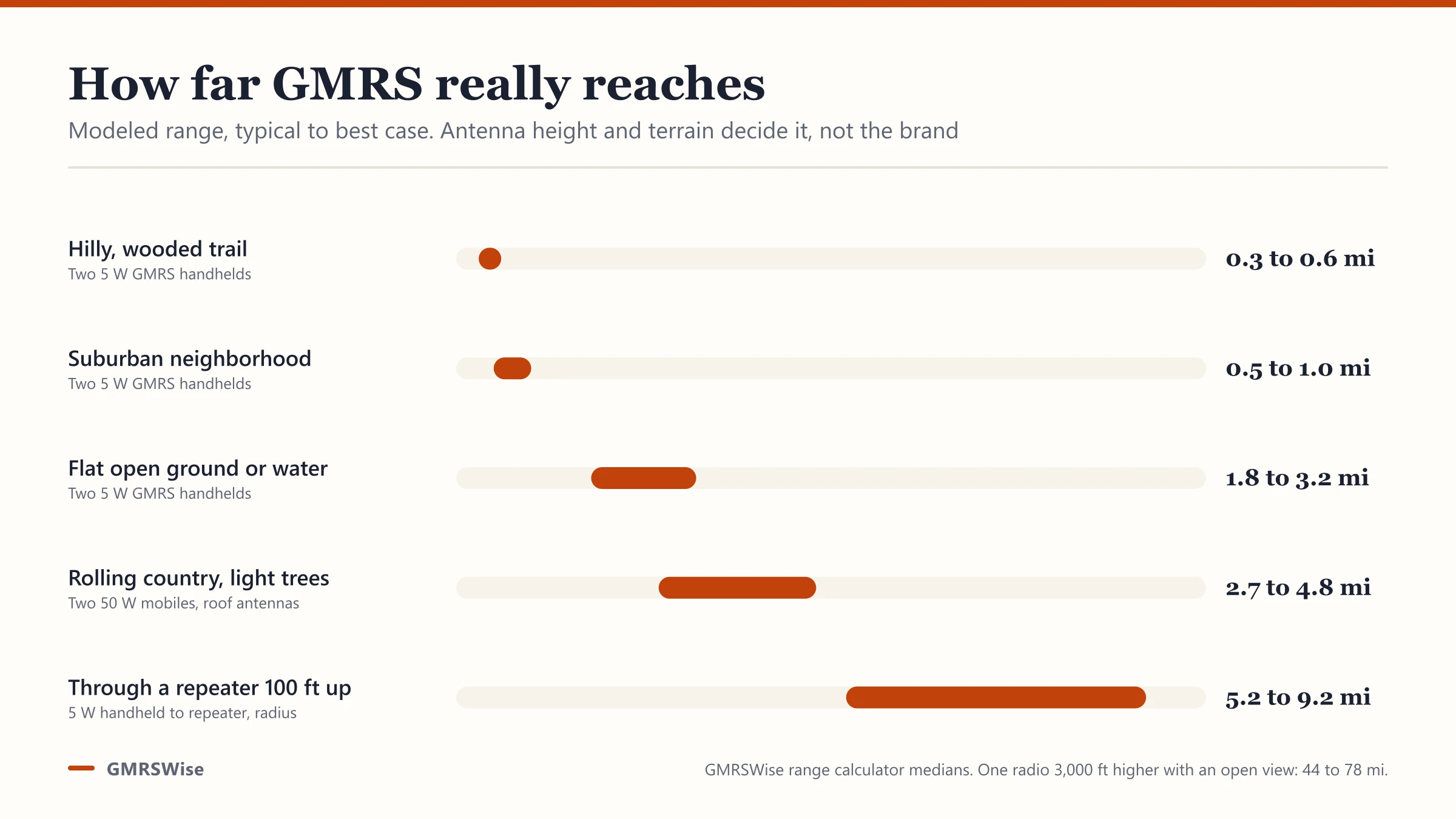
A GMRS handheld reaches about 0.5 to 2 miles between two people on the ground, not the 30 or 50 miles printed on the box. Those box numbers assume one radio on a mountaintop with a clear view of the other. Real GMRS range depends on how high your antenna is and what sits between the radios, far more than on which brand you buy.
How far does a GMRS radio reach?
Two 5 W GMRS handhelds reach roughly half a mile to two miles in everyday conditions. Open, flat ground or water pushes that higher; hills, trees and buildings cut it fast. GMRS is UHF line-of-sight radio, so the signal mostly travels in a straight line and does not bend far over the horizon or through terrain.
Antenna height is the single biggest factor, because raising either antenna extends the line of sight. That is why a vehicle radio with a roof antenna, a base station with a mast, or a repeater on a tower all beat a handheld by a wide margin.
What range can you expect in real conditions?
The table below gives median estimates from our walkie-talkie range calculator, shown as typical to best case, for common GMRS setups.
| Scenario | Radios | Range |
|---|---|---|
| Suburban neighborhood | Two 5 W GMRS handhelds | 0.5 to 1.0 mi |
| Hilly, wooded trail | Two 5 W GMRS handhelds | 0.3 to 0.6 mi |
| Flat open ground or water | Two 5 W GMRS handhelds | 1.8 to 3.2 mi |
| Rolling country, light trees | Two 50 W mobiles, roof antennas | 2.7 to 4.8 mi |
| Through a repeater 100 ft up | 5 W handheld to repeater | 5.2 to 9.2 mi radius |
| One radio 3,000 ft higher | Two 5 W handhelds, open view | 44 to 78 mi |
The last row is how a box gets to a 36-mile claim: it takes the best-possible geometry and treats it as typical. Plan around the first two rows for people on foot in real terrain.
Why are the box range numbers so high?
Makers test range in the single best case: both radios high up, no obstructions, no interference. Midland’s own product FAQ states that its GXT handhelds average one-half to two miles in normal conditions and that the large advertised figure assumes mountaintop to mountaintop.
The number is not a lie so much as a ceiling almost no one reaches on the ground. Treat any range figure over about three miles for a handheld as a line-of-sight maximum, not a daily expectation.
What is the frequency range of GMRS?
GMRS occupies 30 channels between 462.5500 MHz and 467.7250 MHz in the UHF band, set by 47 CFR 95.1763. The eight main channels near 462 MHz carry normal simplex traffic and repeater outputs. The eight channels near 467 MHz are the repeater input frequencies. Fourteen interstitial channels sit between them at lower power.
“GMRS frequency range” and “GMRS range” are two different questions. The frequency range is fixed by the rules and is the same for every GMRS radio. The distance range is what varies with your gear and terrain. The channels and frequencies chart lists each channel and its power limit.
What actually changes GMRS range?
Four things move range, in rough order of impact:
- Antenna height. Raising an antenna extends the line of sight more than anything else. A base antenna on a 30-foot mast can double or triple a rooftop radio’s reach.
- External antenna and gain. A proper vehicle or base antenna beats the stubby antenna on a handheld. The GMRS antenna guide covers gain, mounting and cable loss.
- Repeaters. A repeater on a tall site listens on 467 MHz and rebroadcasts on 462 MHz, letting two handhelds that cannot hear each other both reach the tower. See the GMRS repeater guide.
- Power. Going from 5 W to 50 W helps, but far less than height. Power pushes a signal; it does not make it bend over a hill.
Terrain, trees and buildings work against all four. In dense forest or a city, expect the low end of every estimate.
Does more watts mean more range?
Not as much as most people think. Doubling power does not double range; because signal spreads over area, a large jump in watts buys a modest gain in distance over open ground and almost nothing when a hill is in the way.
A 50 W GMRS mobile radio still outperforms a 5 W handheld, but mostly because it is paired with an external roof antenna mounted higher than a handheld held at chest level. The antenna and its height are doing much of the work, not the watts alone.
How does GMRS range compare to FRS and ham radio?
GMRS reaches a little farther than FRS and about the same as a comparable ham VHF or UHF handheld, with the real difference coming from repeaters and antennas rather than the service itself.
| Setup | Typical ground range |
|---|---|
| FRS handheld, 2 W, fixed antenna | 0.3 to 1.5 mi |
| GMRS handheld, 5 W | 0.5 to 2 mi |
| GMRS 50 W mobile, roof antenna | 2 to 5 mi |
| GMRS through a repeater | 5 to 30 mi radius |
A 5 W GMRS handheld adds only a little over a 2 W FRS radio on the ground, because power does less than height. The jump to a mobile with a roof antenna, or to a repeater, is where GMRS pulls clearly ahead. Compare the services in GMRS vs FRS.
What reduces GMRS range in the real world?
Terrain, trees, buildings and your own body all cut UHF range. Hills and dense forest cause the biggest losses, which is why timber range can drop to a few hundred yards. Holding a radio against your body, or sitting inside a vehicle with no external antenna, also absorbs signal.
Weather has a smaller effect than most people expect. Rain and snow lightly weaken UHF but rarely change usable range much. Interference from other users on your channel is more likely to limit you than weather is; a privacy code reduces the annoyance but does nothing for range.
How can you test your real GMRS range?
Test it rather than trusting the box. Have two people start together, agree to transmit a short count every few minutes, and walk apart until the audio breaks up. Note the distance on a map, and that is your reliable range for that terrain.
Repeat the test in the terrain you actually use, since neighborhood, trail and open-field results differ by miles. The walkie-talkie range calculator gives a starting estimate to compare your field test against.
How do you get the most GMRS range?
Put the antenna as high as you can, use an external antenna instead of a stubby handheld whip, and use a repeater when one is in reach. For a convoy or a base at camp, a vehicle or base radio with a roof or mast antenna is the practical range upgrade. For people on foot, a repeater is the only realistic way past a few miles.
Before you buy, run your own distances through the range calculator for your terrain, and read the GMRS radio guide to match the radio type to how you will actually use it.
Frequently asked questions
Quick answers to what readers ask us most
How far does a GMRS radio reach?
Two handhelds reach about 0.5 to 2 miles on the ground, farther over open water or flat land. A 50 W vehicle radio with a roof antenna reaches several miles, and a repeater can extend coverage to a radius of 5 to 9 miles or more.
Do GMRS radios really reach 30 or 50 miles?
Only with a clear line of sight, such as one radio on a mountain. Those box figures assume mountaintop to mountaintop. Midland's own FAQ says its GXT handhelds average one-half to two miles in normal conditions.
What is the frequency range of GMRS?
GMRS uses 30 channels between 462.5500 and 467.7250 MHz in the UHF band, set by 47 CFR 95.1763. The main channels sit near 462 MHz and the repeater input channels near 467 MHz.
How can I get more range from a GMRS radio?
Raise the antenna, use a vehicle or base radio with an external antenna, and use a repeater. Height and antenna gain beat power. Moving from a 5 W handheld to a 50 W mobile with a roof antenna adds far more range than any brand change.