
GMRS vs FRS: Power, Range, License, and Which One You Need
GMRS vs FRS compared on license, power per channel, antennas, repeaters and real range, and which you need for camping, hiking, off-roading or a neighborhood.
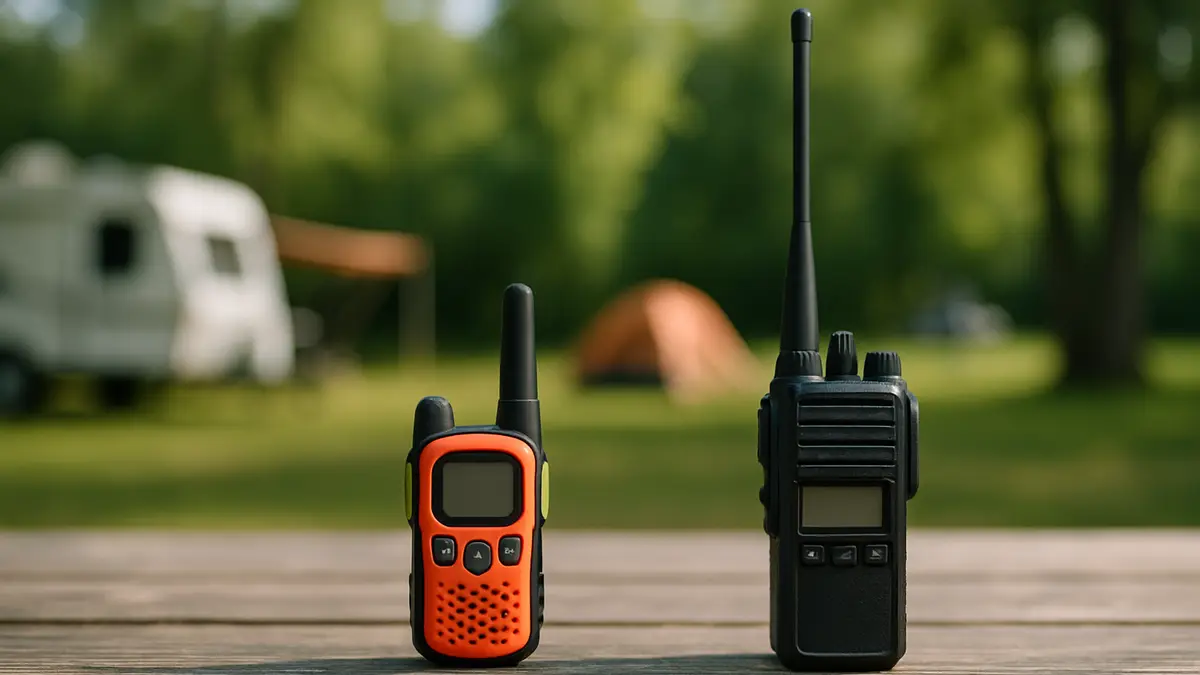
FRS and GMRS look like the same walkie-talkies on the same 22 channels, and in the store they often sit on the same shelf. The difference is in the rules: one is free for anyone with strict limits, the other costs $35 for a license and removes most of those limits. Which one you need depends less on the radio than on where you will use it.
What is the difference between GMRS and FRS?
The Family Radio Service (FRS) is a license-free US radio service with a 2 W cap and fixed antennas; the General Mobile Radio Service (GMRS) is a licensed service on the same channels that allows more power, removable antennas, vehicle and base radios, and repeaters.
| FRS | GMRS | |
|---|---|---|
| License | None | FCC license, $35, 10 years, no exam |
| Who may operate | Anyone | Licensee (18 or older) and immediate family |
| Channels 1 to 7 (462 MHz interstitial) | 2 W ERP | 5 W ERP, handheld, mobile or base |
| Channels 8 to 14 (467 MHz interstitial) | 0.5 W ERP | 0.5 W ERP, handhelds only |
| Channels 15 to 22 (462 MHz main) | 2 W ERP | Up to 50 W output, mobile and base |
| Repeater channels | None | 8 pairs, input on 467 MHz main |
| Antenna | Fixed, integral (95.587) | Removable allowed, except on data-capable handhelds |
| Bandwidth | 12.5 kHz | 20 kHz, 12.5 kHz on channels 8 to 14 |
| Typical radio prices | $40 to $130 per pack | $23 single handheld to $460 for a 50 W mobile |
Rules are from 47 CFR 95.567, 95.587, 95.1705, 95.1767 and 95.1773. Prices are October 2026 store listings from Midland, Baofeng and BTECH.
What is an FRS radio?
An FRS radio is a license-free walkie-talkie certified under the FCC’s Family Radio Service rules: 22 channels, at most 2 W effective radiated power, and an antenna that cannot be removed. FRS dates to 1996, and the FCC’s 2017 rule revision raised its limit from 0.5 W to 2 W on channels 1 to 7 and 15 to 22 and opened channels 15 to 22 to FRS.
Most bubble-pack walkie-talkies, including Motorola Talkabout, most Cobra models and Midland’s X-Talker FRS models, are FRS radios. Anyone may use them, including a business. FRS radios may also send short digital messages, such as a location or a brief text to another FRS or GMRS unit, limited to one second at a time (47 CFR 95.587). Brand-by-brand picks are in our Motorola walkie-talkie guide and the long-range walkie-talkie list.
Do you need a license for FRS or GMRS?
FRS needs no license. GMRS needs an individual FCC license before you transmit: the application fee is $35, the term is 10 years, there is no exam, and the applicant must be at least 18 (47 CFR 95.1705). One license covers the licensee’s immediate family, which the rule defines broadly, from spouses and children to grandparents, in-laws, aunts, uncles, nieces and nephews.
The license does not cover friends, employees or a club, each of whom needs their own. There is one exception: a licensee may let anyone use their GMRS station to send an emergency message (47 CFR 95.1705(c)(3)). The step-by-step application through the FCC’s CORES and ULS systems is in our GMRS license guide.
Is GMRS range really better than FRS?
Handheld to handheld, only slightly. The real range difference comes from what GMRS allows beyond handhelds: vehicle radios, gain antennas and repeaters. We ran the same path through our range calculator, changing only the radios.
| Setup | Rolling ground, light trees | Open flat ground, no trees |
|---|---|---|
| Two FRS handhelds (2 W, fixed antenna) | 0.5 mi | 1.4 mi |
| Two GMRS handhelds (5 W, stock antenna) | 0.6 mi | 1.8 mi |
| Two GMRS handhelds with 0 dBi whips | 0.9 mi | 2.5 mi |
| Two 50 W GMRS mobiles, roof antennas | 2.7 mi | 6.9 mi (horizon-limited) |
| GMRS handheld through a repeater at 100 ft | 5.2 mi radius | 15.1 mi radius |
All figures are reliable-range medians. The “36 mile” or “35 mile” numbers on FRS boxes assume one radio thousands of feet above the other; our model needs about a 3,000 ft height difference to get an FRS pair past 30 miles.
Can FRS and GMRS radios talk to each other?
Yes. FRS and GMRS share channels 1 to 22, so an FRS radio and a GMRS radio on the same channel and the same privacy code setting will hear each other. Only the GMRS repeater channels are off limits to FRS, because FRS radios cannot transmit on the 467 MHz main channels repeaters listen on.
Two details make mixed groups work better. GMRS signals can be up to 20 kHz wide against 12.5 kHz for FRS, so a GMRS radio may sound louder on an FRS radio than the other way around; some GMRS radios, such as Midland’s MXT575, offer a selectable narrow bandwidth. And privacy code numbers differ by brand, so match the actual tone rather than the number. The full frequency list is in our channels and frequencies chart.
What happened to FRS/GMRS combination radios?
They were phased out by the FCC’s 2017 rule changes. The FCC stopped certifying handhelds under both FRS and GMRS on December 27, 2017 (47 CFR 95.1761(d)), and since September 30, 2019 no one may manufacture, import or sell a radio that operates under both services (47 CFR 95.1791).
The same reform added a less obvious rule: the FCC will not certify a handheld as GMRS if it meets the FRS requirements (47 CFR 95.1761(e)). So every GMRS handheld sold today exceeds FRS in some way, usually power above 2 W or a removable antenna. That is why a 2.5 W “GMRS” bubble pack needs a license while a 2 W FRS pack does not, even though their real-world range is close.
Which one do you need?
Choose by where you will use the radios and who will carry them.
| Use | Pick | Why |
|---|---|---|
| Kids, campgrounds, theme parks, ski hills | FRS | Short distances, no license, cheap to replace |
| Family hiking in hills or forest | GMRS handhelds with removable antennas, or FRS if you stay close | A better whip and repeater access help in terrain |
| Off-road and overland convoys | GMRS mobile radios | 15 to 50 W and roof antennas are where range jumps |
| Neighborhood or prepper network | GMRS with a base antenna or repeater | Height and repeaters cover a town, handhelds do not |
| Business staff | FRS or business radios | A GMRS license covers family only |
GMRS picks by budget are in our best GMRS radios comparison, and the bigger picture of what GMRS is and costs is in the GMRS radio guide.
Who should use neither?
Anyone outside the US. FRS and GMRS are US FCC services, and in the EU and UK the license-free equivalent is PMR446, at 446 MHz with 0.5 W and fixed antennas. US FRS and GMRS frequencies are assigned to other users in Europe, so US radios are not a legal substitute there; other countries set their own rules through their national regulator.
Teams that need guaranteed coverage across a large site, such as warehouses or resorts, should also look past both services to business radios. FRS channels are shared with every family nearby, and GMRS cannot legally cover employees.
How we checked
We did not field-test radios. Rules are quoted from the current text of 47 CFR Part 95 Subparts B and E by section. Range figures come from our calculator model, with assumptions listed on the calculator page. Prices come from manufacturer stores, checked October 2026.
Frequently asked questions
Quick answers to what readers ask us most
Do I need a license to use FRS radios?
No. FRS is license-free in the US for anyone, including businesses. You only need a license if the radio is a GMRS radio, which is printed on the box and in the FCC grant.
Can FRS and GMRS radios talk to each other?
Yes. They share channels 1 to 22. Set both radios to the same channel and the same privacy code, or turn codes off. FRS radios cannot use the GMRS repeater channels.
Is GMRS range much better than FRS?
Handheld to handheld, only a little: our model gives about 0.5 miles for FRS and 0.6 miles for GMRS on rolling, lightly wooded ground. The big gains come from GMRS mobile radios, better antennas and repeaters.
How much is a GMRS license and who does it cover?
The FCC fee is $35 for 10 years, with no exam. The licensee must be at least 18, and the license covers immediate family members such as a spouse, children, parents, siblings, grandparents, in-laws, aunts, uncles, nieces and nephews.
Can I use FRS or GMRS radios outside the US?
Not by default. FRS and GMRS are US services. The EU and UK use PMR446 for license-free radios, and US GMRS frequencies are assigned to other users there. Check your national regulator.