
GMRS Antenna Guide: Handheld, Vehicle and Base Upgrades
Which GMRS antenna adds the most range: handheld whips, roof-mount vehicle antennas, base antennas and coax, with modeled gains, loss tables and FCC rules.
Antennas are where most GMRS range is won or lost, and they cost less than a bigger radio. A $34.99 magnet-mount antenna gets a vehicle radio’s signal outside the metal cab, and in our model raising a base antenna from 25 to 40 feet adds more range than stepping a radio up from 15 W to 50 W. This guide ranks the upgrades by how much range they add, then covers the rules that decide what you may change.
Which GMRS antenna upgrade adds the most range?
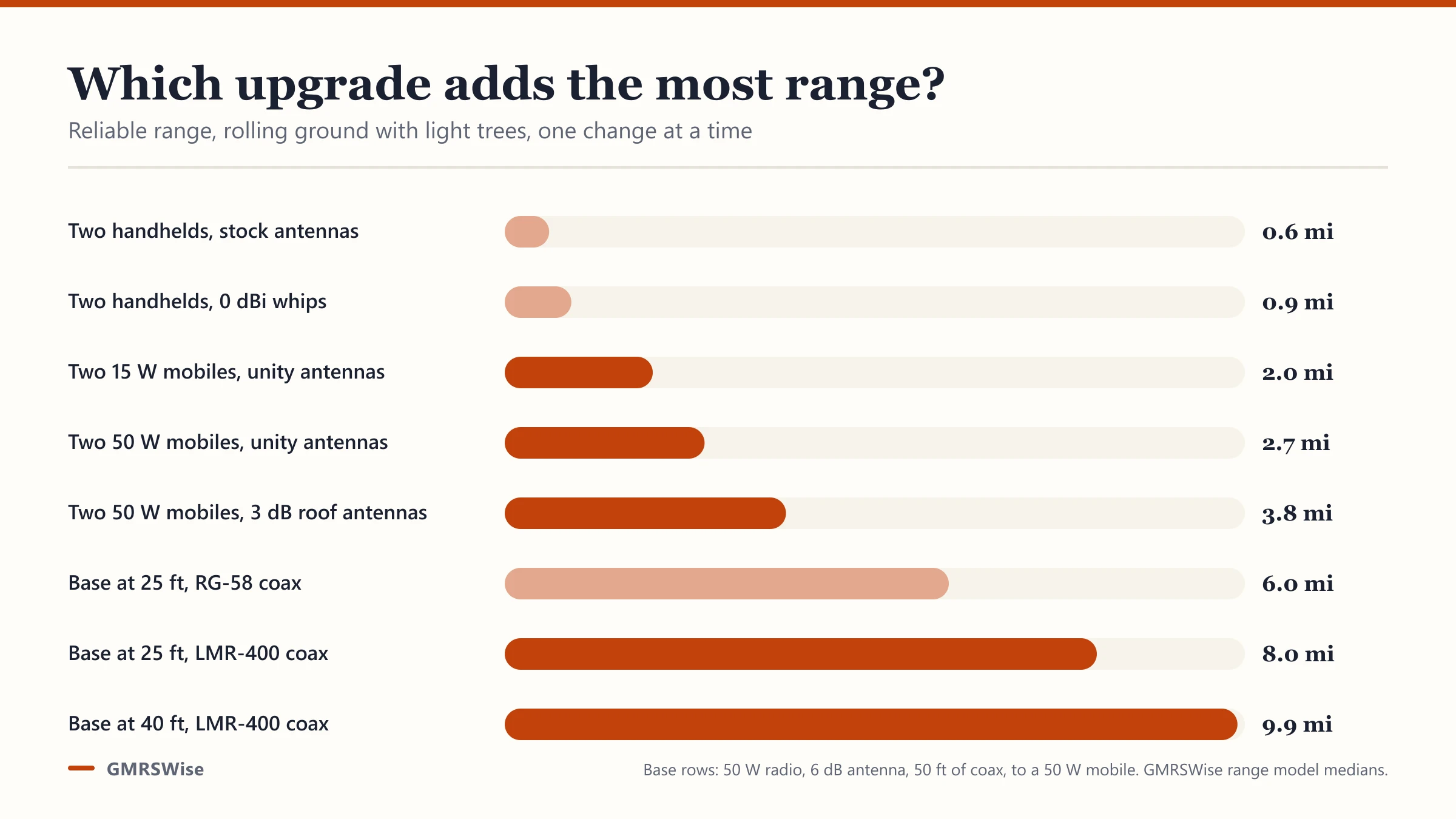
Height and getting the antenna out of the vehicle add the most, coax quality matters at a base station, and wattage adds the least per dollar. We ran each change through our range calculator on the same path, rolling ground with light trees, changing one thing at a time.
| Setup (both ends unless noted) | Reliable range | Best case |
|---|---|---|
| Two GMRS handhelds, stock antennas | 0.6 mi | 1.1 mi |
| Two GMRS handhelds, upgraded 0 dBi whips | 0.9 mi | 1.5 mi |
| Two 15 W mobiles, unity-gain roof antennas | 2.0 mi | 3.5 mi |
| Two 50 W mobiles, unity-gain roof antennas | 2.7 mi | 4.8 mi |
| Two 50 W mobiles, 3 dB gain roof antennas | 3.8 mi | 6.7 mi |
| 50 W base, 6 dB antenna at 25 ft, 50 ft LMR-400, to a 50 W mobile | 8.0 mi | 10.5 mi |
| Same base with the antenna at 40 ft | 9.9 mi | 12.4 mi |
| Same base at 25 ft fed with 50 ft of RG-58 | 6.0 mi | 10.5 mi |
These are median model estimates, not guarantees. Hills, a ridge in the wrong place or dense forest shrink every row.
Can you change the antenna on a GMRS or FRS radio?
On GMRS radios with an antenna connector, yes. On FRS radios, no: 47 CFR 95.587 says the antenna “must be a non-removable integral part of the FRS transmitter type”. That rule is one of the main practical differences covered in our GMRS vs FRS comparison.
One GMRS exception catches buyers: handhelds that send digital data, such as GPS location or short texts, must also have a non-removable antenna (47 CFR 95.1787(a)(4)). That is why radios like the BTECH GMRS-PRO ship with a fixed antenna. Radios with an SMA connector, such as the BTECH GMRS-V2 and the GMRS-certified Baofengs in our Baofeng legality guide, can take an aftermarket whip.
Can a gain antenna make your GMRS station illegal?
Yes, on two channel groups. The limits on GMRS channels 1 to 7 (5 W) and 8 to 14 (0.5 W) are effective radiated power, which counts antenna gain (47 CFR 95.1767). A mobile radio putting 4 W into an antenna with 3 dB of gain over a dipole radiates about 8 W ERP, over the channel 1 to 7 limit.
The main channels 15 to 22 and the repeater channels are limited by transmitter output power, 50 W for mobile and base stations, so antenna gain does not count against them. The practical rule: run high-gain vehicle and base antennas on channels 15 to 22 or a repeater, and keep the interstitial channels for handhelds. Our calculator flags this automatically when you pick a gain antenna.
Which handheld antenna should you buy?
Buy a whip tuned for 462 to 467 MHz with the connector that matches your radio. Most GMRS-certified Baofeng and BTECH handhelds have an SMA-female jack, so they need an SMA-male antenna; check your manual before ordering, because a mismatched connector will not thread on.
Length tells you what you are getting. A quarter wave at 462.6 MHz is about 6.4 inches and a 5/8 wave about 16 inches; stock stubby antennas are usually shorter than either. Avoid antennas tuned only for the 440 to 450 MHz ham band: Comet, an antenna maker, says most amateur antennas show high SWR on GMRS and sells GMRS-tuned models such as the SMA165 (SMA-male) and SMA165J (SMA-female), which are 5/8 wave on GMRS. If you hold a ham license and want antennas for the 2 m and 70 cm bands instead, see our ham radio antennas guide.
Who this is not for: hikers who clip radios to pack straps, where a 16-inch whip snags and breaks, and anyone with a fixed-antenna radio.
Where should a vehicle GMRS antenna go?
On the roof, as close to the center as you can, with the radio’s coax routed inside. A metal roof acts as a ground plane under a quarter-wave or unity antenna, and roof height clears the cab, the cargo and the other vehicles in a convoy. A handheld used inside a car loses much of its signal to the metal body around it.
| Mount | Install | Midland example | Price (Oct 2026) |
|---|---|---|---|
| Magnet mount, unity gain | No drilling | MXTA13, 2.1 dB | $34.99 |
| NMO through-roof, unity | Drilled hole | MXTA51 kit, 2.1 dB | $54.99 |
| NMO, 3 dB gain | Drilled hole or NMO bracket | MXTA25 | $64.99 |
| NMO, 6 dB whip | Drilled hole or NMO bracket | MXTA26 | $74.99 |
| Bull bar or brush guard | Clamp | MXAT series, 3 to 7.5 dB | $184.99 to $314.99 |
Higher gain flattens the pattern toward the horizon, which helps on open ground and can hurt in steep canyons where the other station sits well above or below you. Check SWR with a meter after any install, following the radio and antenna manuals. Picks for the radio itself are in our GMRS mobile and base radio guide.
How much signal does coax cable lose?
At 462 MHz, cheap thin coax loses a lot: about 9 to 13.6 dB per 100 feet for common RG-58 types, against 2.7 dB for LMR-400. On a 15 ft vehicle run, RG-58 costs about 1.4 to 2 dB, which is acceptable. On a 50 ft base station run, it costs about 6.4 dB, which throws away roughly 77 percent of your power before the antenna sees it.
| Cable | Loss per 100 ft at 462 MHz | Loss on a 50 ft run | Power reaching the antenna |
|---|---|---|---|
| RG-58 types | about 9.1 to 13.6 dB | about 4.5 to 6.8 dB | about 21 to 35 percent |
| RG-8X | about 8.2 to 8.4 dB | about 4.1 dB | about 39 percent |
| LMR-240 | about 5.4 dB | about 2.7 dB | about 54 percent |
| RG-213 | about 5.1 dB | about 2.5 dB | about 56 percent |
| LMR-400 | about 2.7 dB | about 1.4 dB | about 73 percent |
Figures are computed from the manufacturers’ attenuation constants (Times Microwave for LMR, Belden for RG types) at 462 MHz with a matched antenna. In our model, swapping 50 ft of LMR-400 for RG-58 on a 25 ft base cuts reliable range to a mobile from about 8.0 to 6.0 miles.
Which base station antenna should you buy?
A fiberglass antenna tuned for 460 to 470 MHz, mounted as high as you can safely manage, fed with LMR-400. Two examples from Comet show the range of choices: the CA-GMRS is 42 inches long with 5.5 dBi gain, an SO-239 connector and a 135 mph wind rating, and the CA-712EFC is 10 feet 5 inches long with 9 dBi gain, an N-female connector and a 112 mph rating.
Height matters more than the gain figure. In our model, moving a 6 dB base antenna from 25 to 40 feet adds about 1.9 miles of reliable range to a 50 W mobile and about 0.6 miles to a handheld. Follow the antenna maker’s mounting instructions, keep any mast well clear of power lines, ground the installation as the National Electrical Code (Article 810) and local building code require, and hire a professional for roof or tower work. For coverage beyond what a home station can reach, look at GMRS repeaters.
Is there a height limit for GMRS antennas?
Not a general one in the current GMRS rules. You will read about a 20-foot limit for GMRS base stations; we found no such cap in the current 47 CFR Part 95 Subpart E text. The height rules that do apply are in 47 CFR 95.317: antenna structures more than 200 feet above ground may require FAA notification and FCC antenna structure registration, and stations on or near military or public-use airports with structures over 20 feet may face extra limits.
Near an airport, the rule caps the antenna top at one meter above airport elevation for every hundred meters from the nearest runway. Local zoning, permits and homeowner association rules may set lower limits than the FCC does, so check them before you buy a mast.
How we checked
We did not field-test antennas. Range figures come from our calculator (radio horizon plus the Egli propagation model, assumptions listed on the calculator page). Coax losses are computed from manufacturer attenuation constants. Antenna specs and prices come from midlandusa.com and cometantenna.com, checked October 2026. Rules are quoted from 47 CFR Part 95 by section.
Frequently asked questions
Quick answers to what readers ask us most
Does a better antenna increase GMRS range?
Yes, often more than extra watts. In our range model, swapping two stock handheld antennas for 0 dBi whips moves reliable range on rolling, lightly wooded ground from about 0.6 to 0.9 miles. Raising a base antenna from 25 to 40 ft adds about 2 miles to a 50 W mobile.
Can I put a bigger antenna on an FRS radio?
No. 47 CFR 95.587 requires the FRS antenna to be a non-removable, integral part of the radio. Only GMRS radios with an antenna connector can take an upgrade.
What coax should I use for a GMRS base station?
LMR-400 or an equivalent low-loss cable for any run over about 25 ft. At 462 MHz it loses about 2.7 dB per 100 ft, against roughly 9 to 13.6 dB for RG-58 types.
Is there a height limit for a GMRS base antenna?
The GMRS rules have no general 20 ft cap. 47 CFR 95.317 requires FAA notice and FCC registration review above 200 ft, and adds limits near airports for structures over 20 ft. Local zoning and HOA rules may also apply.
Is a 6 dB antenna better than a 3 dB antenna on a vehicle?
On flat or rolling ground, usually yes. A higher-gain antenna squeezes signal toward the horizon, so in steep canyons and valleys a unity or 3 dB antenna can work better. Gain also raises ERP on channels 1 to 7, which are capped at 5 W ERP.