
Best GMRS Mobile and Base Station Radios for Car and Home
The best 15 to 50 watt GMRS mobile and base station radios of 2026, compared on power, antenna, waterproofing and October 2026 price, plus install basics.
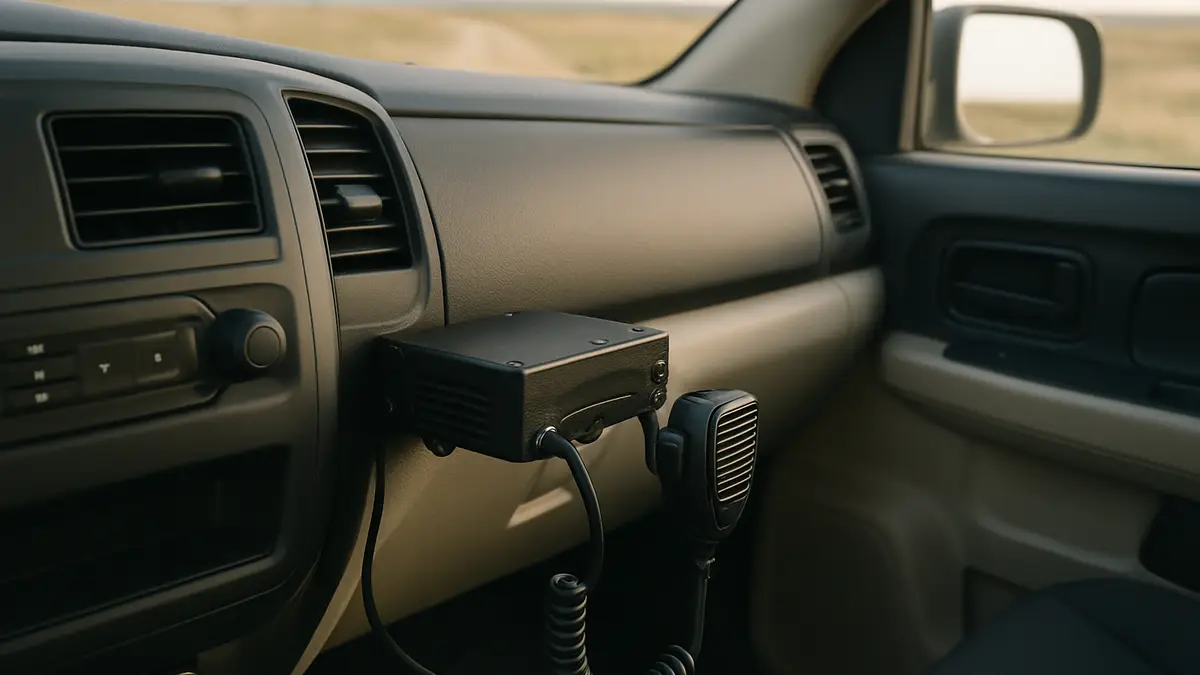
A mobile GMRS radio is the biggest range upgrade available to a licensed family: more power, a roof antenna instead of a stub, and a strong station that handhelds can reach. The same radios become a home base station with a power supply and an outdoor antenna. This page compares the best mobile and base radios on published specs and maker-store prices checked in October 2026. We did not field-test them; range figures come from our range calculator model.
Which GMRS mobile or base radio should you buy? The picks at a glance
| Pick | Radio | Price (Oct 2026) | Power | Repeater | Antenna in the box | Notable |
|---|---|---|---|---|---|---|
| Best overall 50 W | Midland MXT575 | $439.99 | 50 W, Hi/Mid/Lo | Yes, 8 channels, split tones | 2.1 dB NMO antenna, magnet mount | Controls in the microphone, hideaway body |
| Best 15 W value | Midland MXT275 | $199.99 | 15 W | Yes, 8 channels, split tones | 2.1 dB magnet mount, 6 m cable | Controls in the microphone, USB-C |
| Best value 50 W | BTECH GMRS-50X1 | $179.89 (list $219.89) | 50/20/5 W | Yes | None, external antenna required | VHF/UHF scanning receiver, 256 channels |
| Best budget 40 W | Radioddity DB40-G | $179.99 | 40/20/5 W | Yes | None listed | Programming cable included |
| Best for open vehicles | Midland MXT500 | $439.99 | 50 W | Yes, 8 channels | NMO stock antenna, magnet base | IP66 water resistance |
| Best base station | BTECH GMRS-50PRO | $284.89 | 50/25/5 W | Yes | None, tuned antenna needed | Bluetooth, GPS, phone app, IP54 |
| Best waterproof budget | BTECH GMRS-20V2 | $109.89 | 20 W | Yes | Not listed, SO-239 jack | IP67 submersible |
Prices from midlandusa.com, baofengtech.com and radioddity.com, checked October 2026.
Best overall: Midland MXT575 ($439.99)
The Midland MXT575 is the easiest full-power GMRS radio to live with. It delivers 50 watts with high, medium and low settings, supports 8 repeater channels with split tones, and puts every control in the microphone so the radio body hides under a seat or dash. The box includes an NMO stock antenna on a large magnet base, so it works the day it arrives. It also has NOAA weather alerts, 142 privacy codes, a USB-C charging port and a speaker jack.
One detail is worth reading in the manual: its RF-exposure section assumes an antenna of no more than 2.1 dBi and asks for 16 inches (40 cm) between the antenna and people while transmitting. A roof-center mount meets that easily.
Not for: open UTVs, where the IP66 MXT500 fits better, or buyers who want a long warranty: the MXT575 carries 1 year, against 3 years on Midland’s handhelds.
Best 15 W value: Midland MXT275 ($199.99)
The Midland MXT275 is the right first vehicle radio for most families. It runs 15 watts on the 15 high-power GMRS channels (1-7 and 15-22), supports the 8 repeater channels with split tones, and uses the same controls-in-the-microphone design as the MXT575. It ships with a 2.1 dB magnet-mount antenna on a 6 meter cable and a 12 V power cord with a socket plug, so installation can be as simple as plugging it in.
In our calculator, two 15 W mobiles reach about 2.0 miles reliably over rolling, lightly wooded ground, against 2.7 miles for two 50 W radios. For half the price, that is most of the gain.
Not for: rural users relying on long simplex contacts or distant repeaters, where the 50 W radios earn their price.
Best value 50 W: BTECH GMRS-50X1 ($179.89)
The BTECH GMRS-50X1 is the cheapest way to a full 50 watt GMRS radio, at $179.89 on sale from $219.89 in October 2026. It switches between 50, 20 and 5 watts, works with GMRS repeaters, stores 256 channels, and doubles as a VHF and UHF scanning receiver. It is designed by BTECH in South Dakota.
It ships without an antenna: BTECH states an external antenna is required and suggests an NMO mount. The Nagoya antennas in BTECH’s own accessory list run $34.89 to $47.89, plus a mount if your vehicle needs one. Channel programming is done from the keypad or with BTECH’s PC04 cable.
Not for: anyone who wants a plug-in, no-menu radio.
Best budget 40 W: Radioddity DB40-G ($179.99)
The Radioddity DB40-G is a 40 watt mobile with high (at least 40 W), medium (about 20 W) and low (about 5 W) power, repeater support, 50 CTCSS and 104 DCS codes, dual watch, and a UHF scanning receiver. Radioddity includes the programming cable and the radio works with CHIRP software, which suits owners who manage channel plans on a computer.
Radioddity lists a current draw of up to 10 amps at 13.8 volts, which matters for a base station power supply. The difference between 40 and 50 watts is under 1 dB, too small to notice in range.
Not for: buyers who want controls in the microphone or an antenna in the box.
Best for open vehicles: Midland MXT500 ($439.99)
The Midland MXT500 is the 50 watt pick for UTVs, side-by-sides and tractors, where rain reaches the radio. It carries an IP66 water rating, 50 watts, up to 128 channels, 8 repeater channels, 154 privacy codes (50 CTCSS and 104 DCS), a public address function and noise cancelling. Midland includes an NMO stock antenna on a large magnetic base.
Like the MXT575 it has a 1-year warranty. Midland sells it in farm bundles, which tells you its intended home.
Not for: enclosed cars and trucks, where the MXT575’s hideaway design is tidier.
Best base station: BTECH GMRS-50PRO ($284.89)
The BTECH GMRS-50PRO is our base station pick because it is built to sit on a desk as well as in a vehicle: 50, 25 or 5 watts, Bluetooth audio, built-in GPS, phone-app programming, NOAA alert monitoring, IP54 weather resistance and a color control microphone. BTECH’s spec sheet spells out the channel rules plainly: channels 1-7 are limited to 5 W, channels 8-14 are receive-only, and the main channels support full power.
It needs a 13.8 V DC supply indoors and a tuned 50 ohm GMRS antenna. BTECH lists its RPS-30M regulated AC-DC supply at $99.89 as a matching accessory.
Not for: buyers who want a radio without an app or Bluetooth.
Best waterproof budget: BTECH GMRS-20V2 ($109.89)
The BTECH GMRS-20V2 is a 20 watt mobile with an IP67 rating, meaning it survives submersion, which makes it a good fit for boats, open jeeps and farm equipment on a budget. It is repeater compatible, stores 200 channels and uses an SO-239 antenna jack for PL-259 connectors.
The trade-off is power: 20 watts sits between Midland’s 15 W and the 50 W class. Check the listing for what antenna, if any, comes in the box.
Not for: owners who want the simplest possible install.
How much power does a GMRS mobile radio need?
More power helps less than height and antenna placement. In our range calculator, over rolling ground with light trees and roof antennas, two radios reach:
| Radios | Reliable | Best case |
|---|---|---|
| Two 15 W mobiles | 2.0 mi | 3.5 mi |
| Two 50 W mobiles | 2.7 mi | 4.8 mi |
| 50 W mobile talking to a 5 W handheld | 1.0 mi | 1.7 mi |
The last row matters most. A conversation runs both ways, and the handheld’s reply is the weak link, so a 50 W mobile does not stretch contact with people on foot much. A repeater solves that: a 5 W handheld reaches 5.2 to 9.2 miles from a repeater 100 ft up in the same model. The GMRS repeater guide explains access.
Which channels can a mobile or base radio use, and at what power?
Mobile and base radios transmit on 15 of the 22 shared channels. Under 47 CFR 95.1767, channels 15-22 (462 MHz main) allow up to 50 watts output, and channels 1-7 (462 MHz interstitial) are capped at 5 watts ERP. Channels 8-14 (467 MHz interstitial) are reserved for handheld radios at 0.5 watts ERP (95.1763), so mobiles only receive them.
Certified radios are built to these limits, which is why spec sheets list “15 high-power channels”; BTECH’s GMRS-50PRO sheet, for example, states that channels 1-7 are limited to 5 W. For full power, pick a channel between 15 and 22. The 467 MHz main channels are repeater inputs; mobiles transmit there only through a repeater or for brief tests.
What is the difference between a mobile, base and fixed station?
The FCC defines them in 47 CFR 95.303. A mobile station is used in motion or at unspecified stops. A base station sits at a fixed location and talks directly with mobiles and other base stations; it may run up to 50 watts on the main channels. A fixed station talks only to other fixed stations and is capped at 15 watts (95.1767).
For a family, a home radio that talks to vehicles and handhelds is a base station, so the 50 watt limit applies. A control station is a fixed radio that works through a repeater.
How do you install a GMRS mobile radio?
Follow the radio’s installation manual; the steps below are the outline Midland gives for the MXT575, not a substitute for it.
- Mount the radio body and microphone where they do not block airbags, controls or visibility, and avoid drilling near wiring.
- Mount the antenna on the roof, ideally near the center, with the coax routed through grommets and weather stripping, not pinched in a door.
- Connect the red lead, with its in-line fuse, to the fuse block or directly to the battery positive post; connect the black lead to bare metal on the frame.
- For 15 W radios, a 12 V socket plug works; for 50 W radios, use the direct leads.
After any antenna install, check SWR with a meter rated for 462 MHz before regular use.
If you are not comfortable with vehicle wiring, have a car audio or radio installer do it. Antenna choices are in the GMRS antenna guide.
What does a GMRS base station need at home?
A home base station has four parts:
- The radio: any mobile radio on this page.
- A 13.8 V DC regulated power supply rated above the radio’s transmit current. A 40 to 50 W radio can draw around 10 amps; Radioddity lists up to 10 A for the DB40-G.
- An outdoor antenna as high as you can safely mount it. Height adds more range than watts.
- Low-loss coax between them, as short as practical.
Mount masts and route grounding per the antenna maker’s instructions and the National Electrical Code (Article 810 covers radio antennas), or hire a licensed electrician. Antennas taller than 20 feet near an airport, or 200 feet anywhere, fall under FAA and FCC antenna-structure rules (47 CFR 95.317).
Do you need a license for a mobile or base radio?
Yes. Every radio on this page is a GMRS transmitter that requires an FCC GMRS license before you transmit. The license costs $35, needs no exam, lasts 10 years and covers your immediate family and every radio you own. The GMRS license guide walks through the application.
Who this page is not for: handheld-only users (see best GMRS radios), licensed hams shopping for a 2 m and 70 cm mobile (see best mobile ham radios), businesses with employees (Part 90 business radios through a dealer), and anyone outside the US, where these radios are generally not legal to transmit with.
Frequently asked questions
Quick answers to what readers ask us most
Is 15 watts or 50 watts better for a GMRS mobile radio?
50 watts reaches farther, but less than the numbers suggest. In our range model over rolling, lightly wooded ground, two 15 W mobiles reach about 2.0 miles reliably and two 50 W mobiles about 2.7 miles. Antenna height matters as much.
Can I use a GMRS mobile radio as a base station?
Yes. Most base stations are mobile radios on a desk, powered by a 13.8 V DC supply and connected to an outdoor antenna. A base station may run up to 50 watts on the main channels under 47 CFR 95.1767.
Why can't my mobile radio transmit on channels 8 to 14?
Channels 8 to 14 are the 467 MHz interstitial channels, which 47 CFR 95.1763 reserves for handheld radios at no more than 0.5 W ERP. Mobile and base radios receive them but cannot transmit there.
Do I need a license for a GMRS mobile radio?
Yes. Any GMRS transmitter needs an FCC GMRS license: $35, no exam, 10 years. One license covers all your radios and your immediate family.
What antenna comes with a GMRS mobile radio?
Midland includes a 2.1 dB magnet-mount antenna with its MicroMobile radios. Many 50 W radios, such as the BTECH GMRS-50X1, ship without one, so budget for an antenna and mount.