
GMRS Radio Explained: What It Is, Who Needs It, What It Costs
GMRS is a licensed US two-way radio service on 30 UHF channels. What it is, how it differs from FRS, what the $35 license covers, real range, and what gear costs.
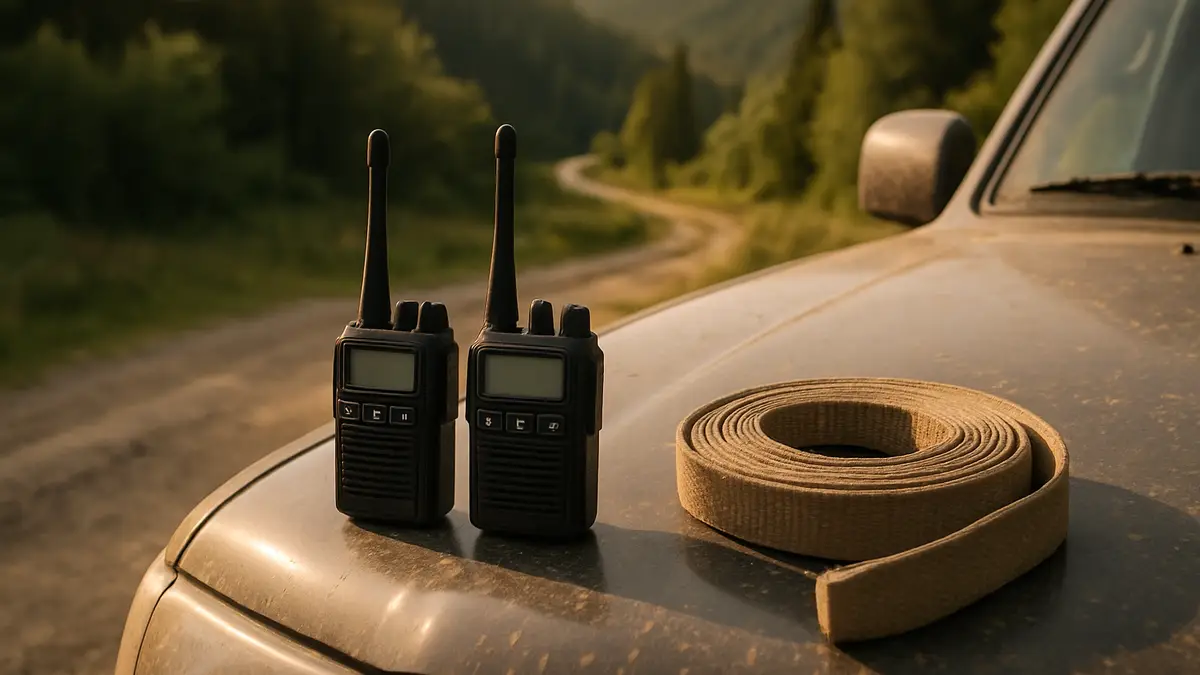
GMRS is the radio service most US families, off-roaders and hunters end up on once a bubble-pack walkie-talkie stops reaching far enough. It is simple to join and cheap to license, but the rules, the channel numbers and the range claims on the box confuse almost everyone. This page explains what GMRS is, who it suits, what it costs and how far it really reaches, with every rule tied to its section of the FCC text.
What is GMRS radio?
GMRS, the General Mobile Radio Service, is a licensed US personal radio service for short-distance two-way voice on 30 UHF channels between 462.5500 and 467.7250 MHz. The rules live in 47 CFR Part 95, Subpart E. Section 95.1763 sets the channels: 16 main channels (8 near 462 MHz, 8 near 467 MHz) and 14 interstitial channels between them.
GMRS supports four kinds of equipment: handheld radios, mobile radios mounted in vehicles, base stations at a home or camp, and repeaters that rebroadcast signals from a tall antenna. Section 95.1731 allows plain-language voice about personal or business activities, emergency messages, traveler assistance, and short GPS location and text data from handhelds.
Who is GMRS for, and who should skip it?
GMRS fits US families and groups who want to stay in touch over a few miles without cell service: trail and overland convoys, hunting camps, ranch and farm chores, ski and hiking trips, and neighborhood emergency plans. It suits people who want more than a toy radio but do not want to study for an exam.
Who it is not for:
- Businesses with employees. No new business GMRS licenses are issued, and a license covers family members, not staff. Business fleets need Part 90 business radios from a dealer.
- Anyone outside the US. GMRS is an FCC service. In Europe and many other countries the license-free equivalent is PMR446.
- People who want worldwide or very long-distance contacts. That is ham radio territory; see GMRS vs ham radio.
Do you need a license for GMRS?
Yes, to transmit. Listening needs no license. The FCC license costs $35, needs no exam, lasts 10 years and is issued only to individuals who are at least 18 (47 CFR 95.1705). The fee dropped from $70 to $35 on April 19, 2022.
One license covers the holder and their immediate family: spouse, children, grandchildren, stepchildren, parents, grandparents, stepparents, siblings, aunts, uncles, nieces, nephews and in-laws. Anyone may use a GMRS station when it is necessary to send an emergency message.
You apply online through the FCC’s CORES and ULS systems. The GMRS license walkthrough covers every screen, the call sign rule and renewal.
How is GMRS different from FRS?
FRS (Family Radio Service) is the license-free service on the same 22 channel frequencies that most bubble-pack walkie-talkies use. GMRS adds power, antennas and repeaters in exchange for the license.
| FRS | GMRS | |
|---|---|---|
| License | None | FCC license, $35 for 10 years |
| Power, channels 1-7 and 15-22 | 2 W ERP | 5 W ERP on 1-7; up to 50 W output on 15-22 from mobile and base radios |
| Power, channels 8-14 | 0.5 W ERP | 0.5 W ERP, handhelds only |
| Antenna | Fixed, cannot be removed | Removable allowed (except handhelds that send data) |
| Repeaters | No | Yes, 8 repeater pairs |
| Vehicle and base radios | No | Yes |
Sources: 47 CFR 95.567 and 95.587 (FRS), 95.1767 and 95.1787 (GMRS). The full side-by-side, including which radios can talk to which, is in GMRS vs FRS.
What can a GMRS radio do that an FRS radio cannot?
Three things. First, power: mobile and base stations may run up to 50 watts output on the eight 462 MHz main channels (channels 15-22). Second, antennas: a GMRS radio can use a removable antenna, so a vehicle radio can feed a roof antenna and a home radio can feed one on a mast. FRS radios must have a non-removable antenna no better than a half-wave dipole.
Third, repeaters. A repeater listens on a 467 MHz input channel and rebroadcasts on the paired 462 MHz channel from a tall site, so two handhelds that cannot hear each other can both reach the tower. Repeaters are owned by individuals and clubs, and most expect you to ask before using them. The GMRS repeater guide explains how to find one and get access.
How far does a GMRS radio reach?
Much less than the box says, unless one radio is on a mountain. Midland’s own product FAQ says its GXT handhelds average one-half to two miles in normal conditions, and that the “36 mile” figure assumes mountaintop to mountaintop.
Our walkie-talkie range calculator gives these median estimates (reliable to best case):
| Scenario | Radios | Range |
|---|---|---|
| Suburban neighborhood | Two 5 W GMRS handhelds | 0.5 to 1.0 mi |
| Hilly, wooded trail | Two 5 W GMRS handhelds | 0.3 to 0.6 mi |
| Flat open ground or water | Two 5 W GMRS handhelds | 1.8 to 3.2 mi |
| Rolling country, light trees | Two 50 W mobiles, roof antennas | 2.7 to 4.8 mi |
| Through a repeater 100 ft up | 5 W handheld to the repeater | 5.2 to 9.2 mi radius |
| One radio 3,000 ft higher | Two 5 W handhelds, open view | 44 to 78 mi |
Antenna height and repeaters change range far more than the radio brand does.
What does GMRS cost?
A working GMRS setup costs $35 for the license plus $26 to $440 per radio, depending on type. Prices below are from the makers’ own US stores, checked October 2026.
| Item | Example | Price (October 2026) |
|---|---|---|
| FCC license | 10 years, whole family | $35 |
| Budget handheld | Baofeng GM-15 Pro | $25.99 each |
| Family handheld pair | Midland GXT1000VP4 | $99.99 per pair |
| Rugged 5 W handheld | Midland GXT67 Pro | $219.99 each |
| 15 W vehicle radio | Midland MXT275 | $199.99 |
| 50 W vehicle radio | Midland MXT575 | $439.99 |
| Personal repeater | Midland MXR10 | $399.99 |
Repeater access is usually free, at the owner’s discretion. There is no monthly fee anywhere in GMRS.
Which type of GMRS radio should you start with?
Start with handhelds if you walk, hunt or ski, because the radio goes where you go. Our best GMRS radios comparison ranks handhelds on certification, power, removable antenna, repeater support and water rating.
Start with a vehicle radio if you travel in convoys or live where a repeater is in reach. A 15 to 50 watt mobile radio with a roof antenna outperforms any handheld by a wide margin; in our calculator, two 50 W mobiles reach about 2.7 miles reliably over rolling, lightly wooded ground, where two handhelds manage about 0.6 miles. The best GMRS mobile and base radios page covers those, plus home base setups.
Most families end up with both: handhelds for people on foot, one mobile or base radio as the strong station that can hear them.
What rules do GMRS users have to follow?
The day-to-day rules are short. Say your FCC call sign at the end of a transmission or series of transmissions, and at least every 15 minutes during a long one, in English or Morse code (47 CFR 95.1751). Use only FCC-certified GMRS radios (95.1761); radios sold for amateur use, such as the classic Baofeng UV-5R, are not certified for GMRS.
Section 95.1733 prohibits music and entertainment, advertising, false or coded messages (ten-codes are allowed), and continuous transmission except for immediate safety. Stay on the right power for each channel group; certified radios enforce this automatically. The channels and frequencies chart lists the limits channel by channel.
Can you use GMRS outside the United States?
No. A US GMRS license authorizes operation under FCC rules, and other countries assign the 462 and 467 MHz frequencies differently. Europe, the UK and many other countries use PMR446, a license-free service near 446 MHz with low power and fixed antennas. Canada, Mexico, Brazil and the Gulf states each have their own regulator and rules. If you travel, check the national regulator before you transmit, and use radios approved for that country.
What should you do next?
- Decide whether license-free FRS is enough, using GMRS vs FRS and the range calculator.
- If you need GMRS, get the license first with the license walkthrough. It covers your family.
- Buy certified radios: handhelds for people on foot, a mobile or base radio for the strong station.
- Agree on a channel and privacy code with your group, then look for a nearby repeater if you need more range.
Frequently asked questions
Quick answers to what readers ask us most
Is GMRS free to use?
No. Transmitting on GMRS requires an FCC license that costs $35 and lasts 10 years. There is no exam and no monthly fee. Listening to GMRS channels needs no license.
Can my kids use my GMRS license?
Yes. Under 47 CFR 95.1705 a licensee may let immediate family members operate, including children and grandchildren. Under 95.1743 the license holder is responsible for anything a minor does on the air.
Can GMRS radios talk to FRS walkie-talkies?
Yes. FRS and GMRS share the same 22 channel frequencies, so a GMRS radio and an FRS radio on the same channel and privacy code can talk. The FRS radio stays at its lower power.
Is GMRS the same as ham radio?
No. GMRS is a personal service with a fee-only license and 30 fixed channels near 462 and 467 MHz. Ham radio needs an exam and opens many bands. See our GMRS vs ham radio comparison.
Can I use a GMRS radio outside the United States?
Not under a US license. GMRS is an FCC service. Europe and many other countries use PMR446 for license-free radios, and each country's regulator decides what is legal there.