
GMRS Repeaters: How to Find, Access and Program One
How GMRS repeaters work, how much range they add, how to find repeaters near you, how to ask for access, and the exact offset and tone settings to program.
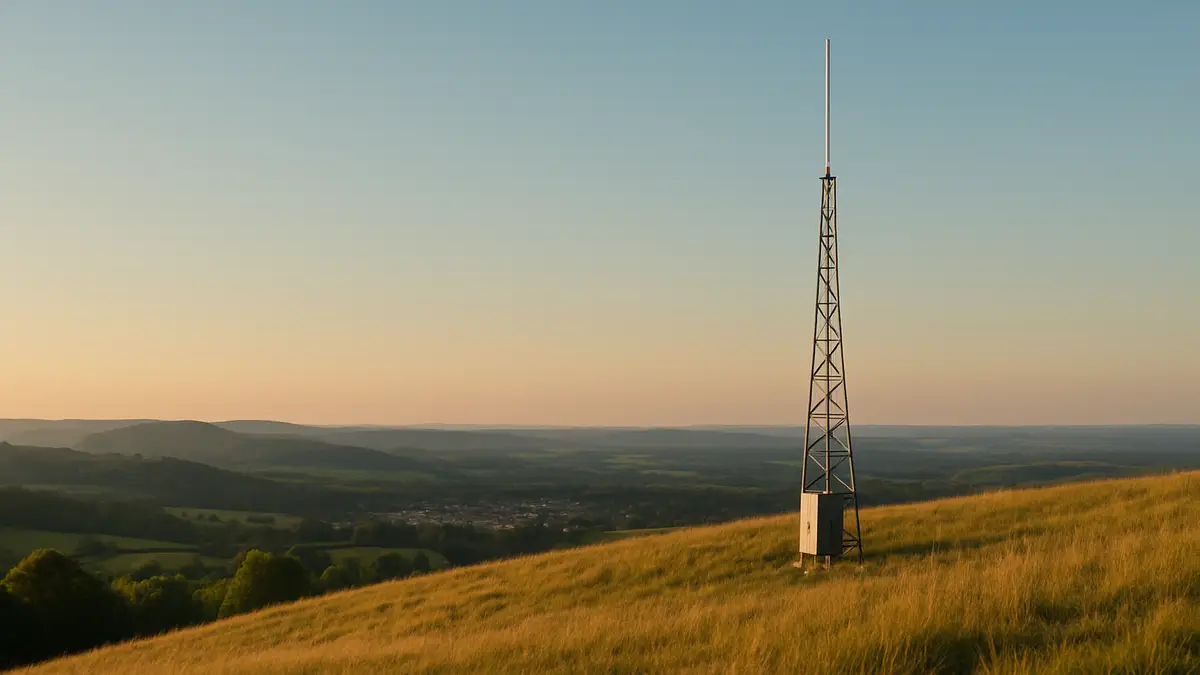
The biggest range upgrade in GMRS is not a better radio or a taller antenna on your car. It is someone else’s antenna, 100 feet up a tower, that repeats your signal. This page explains what a GMRS repeater does, how to find one, how to get permission, and the exact settings to program into your radio.
What is a GMRS repeater?
A GMRS repeater is a GMRS station that receives on one of the 8 repeater input channels (467.5500 to 467.7250 MHz) and simultaneously retransmits what it hears on the paired 462 MHz main channel, 5 MHz lower. Repeaters are usually on towers, tall buildings or hilltops, and may transmit up to 50 W output (47 CFR 95.1767).
Your radio talks up to the repeater and everyone within the repeater’s coverage hears you on the output. Because the repeater’s antenna is far higher than yours, it sees over hills, trees and houses that block a direct path between two handhelds. Repeaters are licensed and run by individual GMRS licensees, clubs and families, not by the FCC.
How much range does a repeater add?
A repeater typically multiplies handheld range several times over. Our walkie-talkie range calculator gives these figures for a 100 ft repeater at 50 W with a 6 dB gain antenna and 3 dB of feedline and duplexer loss:
| Scenario | Direct (radio to radio) | Through the repeater |
|---|---|---|
| 5 W handhelds, rolling ground, light trees | 0.6 to 1.1 miles | 5.2 to 9.2 miles from the repeater |
| 50 W mobiles, rolling ground, light trees | 2.7 to 4.8 miles | 14.5 to 17.6 miles from the repeater |
| 5 W handhelds, hills, light trees | 0.3 to 0.6 miles | 2.8 to 5.0 miles from the repeater |
| 50 W mobiles, hills, light trees | 1.5 to 2.6 miles | 7.8 to 13.9 miles from the repeater |
Repeater figures are a radius around the repeater, so two users on opposite sides can be twice that distance apart. The 17.6 mile ceiling is the radio horizon between a 100 ft antenna and a car roof. Real coverage depends on the actual terrain, which the model does not map.
Do you need a license to use a GMRS repeater?
Yes, two kinds of permission. First, your own FCC GMRS license: every GMRS transmission needs one, and a license covers your immediate family. The process is in our GMRS license guide. Second, the owner’s permission. Under 47 CFR 95.1705, a repeater licensee “may allow any person to use” the repeater or may limit its use to specific people.
Many repeaters are open to any licensed user who asks; some are private to a family, club or emergency group. The access tone is often shared only after you ask, which is how owners keep control. FRS radios cannot use repeaters at all, because they cannot transmit on the 467 MHz input channels.
How do you find GMRS repeaters near you?
Search a directory rather than scanning blind. Two directories cover most US GMRS repeaters:
- myGMRS.com: a community site with a GMRS repeater directory, a license lookup and forums.
- RepeaterBook GMRS: a community-compiled database with proximity and map search. In October 2026 its state index listed about 1,700 GMRS repeaters, with Florida (119), California (90) and Pennsylvania (89) at the top.
Then check local sources: off-road clubs, CERT and neighborhood emergency groups, and county or regional GMRS groups often run or know their area’s repeaters. We do not publish per-city repeater lists; directories maintained by owners stay current, and a static list would not.
How do you ask for access to a repeater?
Contact the owner through the directory listing or the club that runs it, and give your name and GMRS call sign. Owners want to see a valid license; anyone can confirm it in the FCC’s ULS license search. Say how you plan to use the repeater, for example daily family check-ins or weekend trail runs.
Wait for the reply before transmitting. A repeater that does not respond to your test without the tone is working as intended. Once you have the tone, use it only on that repeater, and do not pass it on without the owner’s say. If the owner never replies, try another listing nearby; dead listings are common in any volunteer directory.
How do you program a radio for a GMRS repeater?
You need a GMRS radio with repeater capability, which means it can transmit on the 467 MHz main channels. Many GMRS handhelds and most GMRS mobiles have it; FRS radios never do, and some budget GMRS handhelds do not, so check the manual before you buy. For vehicle radios, see best GMRS mobile radios.
| Setting | What to enter | Example: repeater on channel 20 |
|---|---|---|
| Receive frequency | The repeater’s 462 MHz output | 462.6750 MHz |
| Transmit frequency | Output plus 5 MHz | 467.6750 MHz |
| Mode | Repeater, duplex or “R” channel | Channel 20R |
| Transmit tone | The owner’s access tone | CTCSS 141.3 Hz |
| Receive tone | Optional, the repeater’s output tone | 141.3 Hz or off |
| Bandwidth | Wide (20 kHz) | Wide |
On radios with fixed repeater channels, you only select the “R” channel and set the transmit code. If you set codes by number, look up the tone in Hz; our privacy codes chart lists all 38 CTCSS tones and 104 DCS codes. The full frequency list is in the GMRS channel chart. On radios that CHIRP supports, you can enter the same settings from a computer; see how to program a radio with CHIRP.
What is the travel tone?
The travel tone is an informal convention: many GMRS users and some repeaters use a 141.3 Hz CTCSS tone, often on channel 20, so travelers can reach someone without knowing the local tone. It is code 22 in the common 38-code numbering.
It is not an FCC rule, and most repeaters do not open on it. Treat it as one more thing to try when you are away from home, after checking the directories for the repeaters along your route.
What rules apply when you talk on a repeater?
Repeater operation follows the same GMRS rules as any other transmission:
- Identify: give your call sign at the end of a transmission and at least every 15 minutes during a longer exchange, by voice in English or by Morse tone (47 CFR 95.1751).
- Keep test transmissions brief: mobile and handheld radios may transmit on 467 MHz main channels only through a repeater or for brief tests (95.1763).
- Give emergencies priority: any GMRS channel may carry emergency traffic, which always comes first (95.1731).
- Leave gaps: pause a second or two between transmissions so another user can break in.
- No music, advertising or coded messages (95.1733).
Can you put up your own GMRS repeater?
Yes. Any GMRS licensee may operate a repeater under their license, transmitting on a 462 MHz main channel at up to 50 W output. A repeater needs a duplexer so one antenna can transmit and receive at the same time, plus an antenna as high as you can legally and safely mount it. Follow the equipment manual for installation, and use a licensed electrician or tower professional for anything beyond plug-in power and a simple mast.
Owners may control repeaters remotely over a network (47 CFR 95.1745 and 95.1749), but the FCC’s GMRS guidance says repeaters may not be linked via the internet to extend coverage. Height matters more than power for coverage; our GMRS antenna guide explains why.
Who is this guide not for?
GMRS repeaters are a US service under FCC rules. Outside the US, license-free PMR446 radios have no repeater channels, and the rules differ by country. If no repeater covers your area and you need regional range, a 50 W mobile with a roof antenna is the next step, and ham radio offers a far larger repeater network for people willing to pass an exam. If your group stays within a mile, you do not need a repeater at all.
Where do these numbers come from?
Rules: 47 CFR Part 95 Subpart E, sections 95.1705, 95.1731, 95.1733, 95.1745, 95.1749, 95.1751, 95.1763 and 95.1767, current eCFR text checked October 2026. The internet-linking position: the FCC’s GMRS operations guidance, as cited in Wikipedia’s General Mobile Radio Service article. Travel tone: Wikipedia’s GMRS article, which notes the convention is informal. Listing counts: the RepeaterBook GMRS state index, read October 6, 2026. Range: the GMRSWise range model, assumptions listed on the calculator page.
Frequently asked questions
Quick answers to what readers ask us most
Do I need a license to use a GMRS repeater?
Yes. Every GMRS transmission, including through a repeater, needs your own FCC GMRS license ($35, 10 years, no exam). You also need the repeater owner's permission, since 47 CFR 95.1705 lets owners limit who may use their repeater.
Can FRS radios use GMRS repeaters?
No. Repeater inputs are on the 467 MHz main channels, which FRS radios cannot transmit on. You need a GMRS radio with repeater capability.
How far can you talk through a GMRS repeater?
In our range model, a 5 W handheld reaches about 5 to 9 miles from a 100 ft repeater over rolling ground with light trees, against about 1 mile direct. A 50 W mobile reaches about 15 miles or more. Hills and buildings cut this.
What is the GMRS repeater offset?
Plus 5 MHz. Your radio transmits on the 467 MHz input and listens on the 462 MHz output. Example: repeater on channel 20 listens on 467.6750 MHz and transmits on 462.6750 MHz.
Can GMRS repeaters be linked over the internet?
No. The FCC's GMRS guidance says repeaters may not be linked via the internet to extend coverage, based on 47 CFR 95.1733(a)(8) and 95.1749. Remote control of a repeater over a network is allowed.