
GMRS and FRS Channels and Frequencies: Full Chart
All 30 GMRS channels and the 22 FRS channels with exact frequencies, the legal power for each group, bandwidth, and which radios may use which channel.
Every GMRS and FRS radio sold in the US uses the same 22 channel numbers, but the power you may use, the bandwidth and even which radio may transmit change from one group of channels to the next. This page is the reference chart, taken from the current FCC rule text rather than from packaging.
How many GMRS channels are there?
GMRS has 30 channels: 16 main channels and 14 interstitial channels, set out in 47 CFR 95.1763. Radios number 22 of them as channels 1-22, the same numbers FRS radios use. The remaining 8 are the 467 MHz main channels, which work only as repeater inputs and usually appear as 15R-22R or as a repeater mode on channels 15-22.
FRS has 22 channels, all 12.5 kHz wide (47 CFR 95.563), and they are the same frequencies as GMRS channels 1-22. That shared spectrum is why a license-free FRS bubble pack and a 50 W GMRS mobile in a truck can talk to each other.
An interstitial channel sits 12.5 kHz between two main channels. Channel 1 (462.5625 MHz), for example, sits between channel 15 (462.5500) and channel 16 (462.5750).
What is the full GMRS and FRS frequency chart?
Channels 1-22 are the same frequencies on every current FRS and GMRS radio, but the legal power depends on the group the channel falls in and on which service you are using. Channels 1-7 and 15-22 are on 462 MHz, and channels 8-14 are on 467 MHz. The frequencies below are the five-decimal values from the FCC tables.
| Channel | Frequency (MHz) | GMRS power limit | FRS power limit | GMRS bandwidth |
|---|---|---|---|---|
| 1 | 462.5625 | 5 W ERP | 2 W ERP | 20 kHz |
| 2 | 462.5875 | 5 W ERP | 2 W ERP | 20 kHz |
| 3 | 462.6125 | 5 W ERP | 2 W ERP | 20 kHz |
| 4 | 462.6375 | 5 W ERP | 2 W ERP | 20 kHz |
| 5 | 462.6625 | 5 W ERP | 2 W ERP | 20 kHz |
| 6 | 462.6875 | 5 W ERP | 2 W ERP | 20 kHz |
| 7 | 462.7125 | 5 W ERP | 2 W ERP | 20 kHz |
| 8 | 467.5625 | 0.5 W ERP, handheld only | 0.5 W ERP | 12.5 kHz |
| 9 | 467.5875 | 0.5 W ERP, handheld only | 0.5 W ERP | 12.5 kHz |
| 10 | 467.6125 | 0.5 W ERP, handheld only | 0.5 W ERP | 12.5 kHz |
| 11 | 467.6375 | 0.5 W ERP, handheld only | 0.5 W ERP | 12.5 kHz |
| 12 | 467.6625 | 0.5 W ERP, handheld only | 0.5 W ERP | 12.5 kHz |
| 13 | 467.6875 | 0.5 W ERP, handheld only | 0.5 W ERP | 12.5 kHz |
| 14 | 467.7125 | 0.5 W ERP, handheld only | 0.5 W ERP | 12.5 kHz |
| 15 | 462.5500 | 50 W output | 2 W ERP | 20 kHz |
| 16 | 462.5750 | 50 W output | 2 W ERP | 20 kHz |
| 17 | 462.6000 | 50 W output | 2 W ERP | 20 kHz |
| 18 | 462.6250 | 50 W output | 2 W ERP | 20 kHz |
| 19 | 462.6500 | 50 W output | 2 W ERP | 20 kHz |
| 20 | 462.6750 | 50 W output | 2 W ERP | 20 kHz |
| 21 | 462.7000 | 50 W output | 2 W ERP | 20 kHz |
| 22 | 462.7250 | 50 W output | 2 W ERP | 20 kHz |
FRS radios use 12.5 kHz on every channel. The 50 W figure is transmitter output for mobile, base and repeater stations; fixed stations are capped at 15 W (47 CFR 95.1767).
What are the GMRS repeater input frequencies?
The 8 repeater inputs are the 467 MHz main channels, exactly 5 MHz above channels 15-22. A repeater listens on the 467 MHz input and retransmits on the matching 462 MHz output.
| Repeater channel | Your radio transmits (input) | Repeater transmits (output) |
|---|---|---|
| 15R | 467.5500 | 462.5500 |
| 16R | 467.5750 | 462.5750 |
| 17R | 467.6000 | 462.6000 |
| 18R | 467.6250 | 462.6250 |
| 19R | 467.6500 | 462.6500 |
| 20R | 467.6750 | 462.6750 |
| 21R | 467.7000 | 462.7000 |
| 22R | 467.7250 | 462.7250 |
Under 47 CFR 95.1763, mobile and handheld radios may transmit on these 467 MHz main channels only when talking through a repeater or making brief test transmissions. FRS radios cannot use them at all. Finding and programming a repeater is covered in GMRS repeaters.
Which radios may transmit on which channels?
The channel groups exist because the FCC limits station types, not only power. From 47 CFR 95.1763:
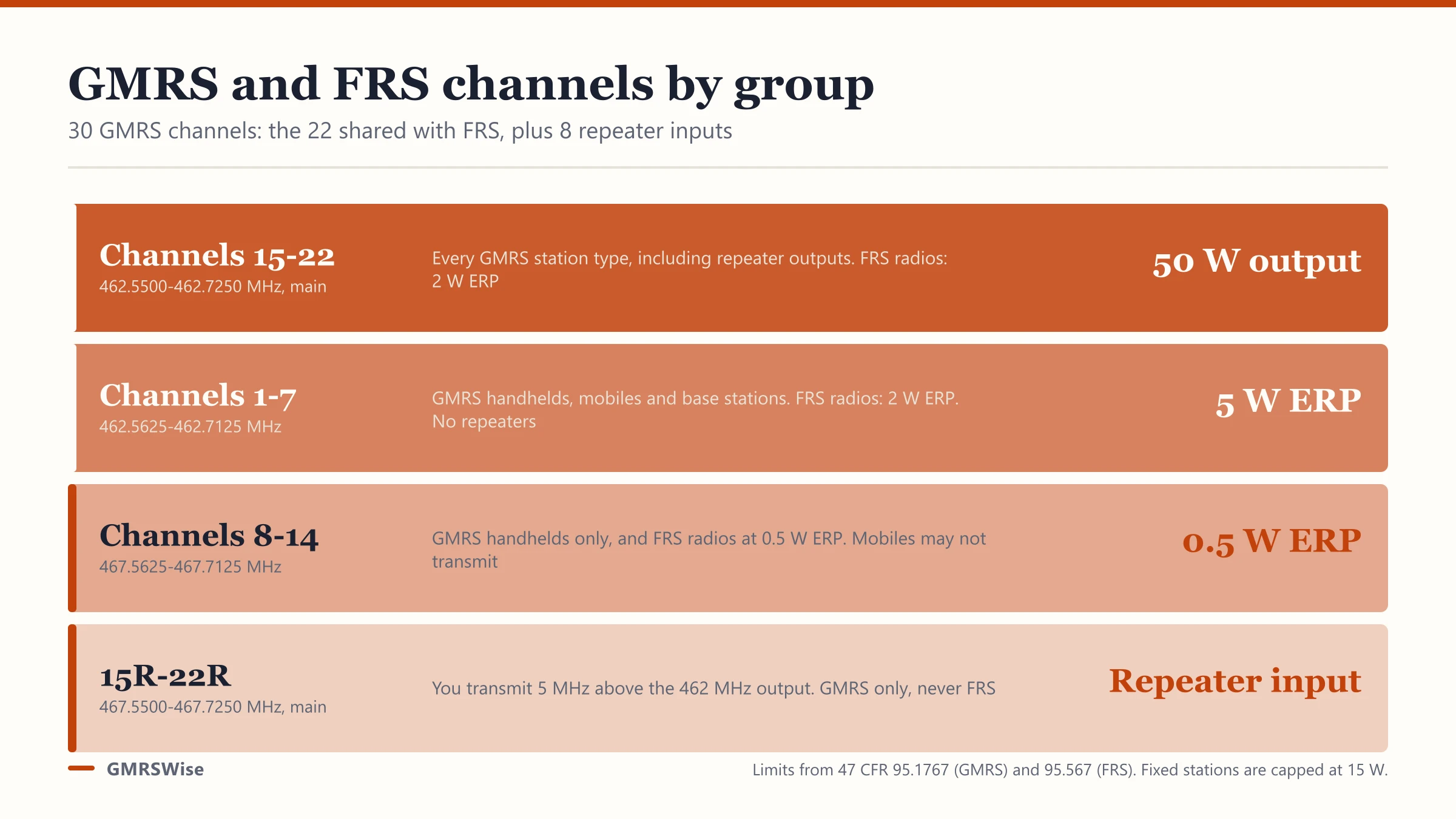
- Channels 1-7 (462 MHz interstitial): GMRS handhelds, mobiles and base stations, at 5 W ERP. FRS radios at 2 W ERP. No repeaters.
- Channels 8-14 (467 MHz interstitial): GMRS handhelds only, at 0.5 W ERP, and FRS radios at 0.5 W ERP. A GMRS mobile or base radio may not transmit here.
- Channels 15-22 (462 MHz main): every GMRS station type, including repeater outputs, up to 50 W. FRS radios at 2 W ERP.
- 15R-22R (467 MHz main): GMRS repeater inputs only.
ERP (effective radiated power) includes antenna gain, so a 5 W ERP cap on channels 1-7 is tighter than a 5 W transmitter output rating. Certified radios are built to stay inside these limits on each channel; that is one reason GMRS transmission requires an FCC-certified Part 95E radio and a GMRS license.
How much range does each channel group give?
Power differences between channel groups matter less than antenna height, but they still show up. Our walkie-talkie range calculator gives these figures for two radios at head height (vehicles at roof height) over open rolling ground with no trees:
| Radio and channel group | Reliable to best-case range |
|---|---|
| FRS handheld, channels 8-14 (0.5 W) | 0.5 to 1.0 miles |
| FRS handheld, channels 1-7 or 15-22 (2 W) | 0.8 to 1.4 miles |
| GMRS handheld, 5 W | 1.0 to 1.7 miles |
| GMRS 50 W mobile, channels 15-22, roof antennas | 4.2 to 6.9 miles |
The jump to the mobile comes from roof antennas and power together. For anything longer, a repeater on channels 15-22 is the tool; a 100 ft repeater typically stretches a handheld to 5 miles or more in the same model.
Is there an emergency or calling channel?
No channel is reserved for emergencies by FCC rule. 47 CFR 95.1731 says any GMRS channel may be used for emergency communications or traveler assistance, and that emergency traffic has priority on every channel at all times.
By informal convention, many GMRS users treat channel 20 (462.6750 MHz) as a national calling and traveler-assistance channel, often with a 141.3 Hz tone. It is a community habit, not a rule, so there is no guarantee anyone is listening. CB, by contrast, does have a rule-based emergency channel: CB channel 9.
Why do channel numbers differ between radios?
The 22 shared channel numbers are standard on current FRS and GMRS handhelds, but repeater channels are not. Some radios label them 15R-22R, some list them as channels 23-30, and some put the repeater setting inside a menu on channels 15-22. Older GMRS-only radios built before the 2017 rule changes may number channels their own way.
Always match radios by frequency, not by the number on the screen. If two radios on “channel 20” cannot hear each other, check that both are on 462.6750 MHz, both are in simplex (not repeater) mode, and both use the same privacy code or none.
What changed in the 2017 FRS and GMRS rules?
The FCC’s 2017 overhaul of Part 95 created the shared 22-channel layout used today. FRS radios gained channels 15-22 and a 2 W ERP limit on channels 1-7 and 15-22, where previously FRS ran 0.5 W on all of its channels. FRS also gained the right to send short location and text data, limited to one second per transmission and one transmission every 30 seconds (47 CFR 95.587).
The FCC stopped certifying combination FRS/GMRS handhelds after December 27, 2017 (47 CFR 95.1761), and selling them became unlawful after September 30, 2019. A radio today is either FRS or GMRS, which is why the box tells you which one you are buying. See GMRS vs FRS for how to pick.
Who is this chart not for?
This chart is for the United States. GMRS and FRS are FCC services. In the EU, the UK and many other countries, the license-free band is PMR446 at 446 MHz, and US GMRS radios are generally not permitted there because 462 and 467 MHz are assigned to other users. Check your national regulator before transmitting outside the US. Business users who need private channels should look at Part 90 business radio, not GMRS. For the overview of what GMRS is, start with the GMRS radio guide.
Where do these numbers come from?
Frequencies, power, station types and bandwidths: 47 CFR Part 95 Subpart B (FRS, sections 95.563, 95.567, 95.573, 95.587) and Subpart E (GMRS, sections 95.1731, 95.1761, 95.1763, 95.1767, 95.1773), current eCFR text checked October 2026. Range: the GMRSWise range model (radio horizon plus Egli path loss, stock handheld antennas, 10 dB fade margin for “reliable”), with assumptions listed on the calculator page.
Frequently asked questions
Quick answers to what readers ask us most
How many channels does GMRS have?
30. There are 16 main channels and 14 interstitial channels under 47 CFR 95.1763. Radios show 22 of them as channels 1-22, shared with FRS, and the other 8 are repeater inputs, often labeled 15R-22R.
What is the GMRS emergency channel?
There is no official one. Channel 20 (462.6750 MHz) with a 141.3 Hz tone is an informal calling and traveler-assistance convention. The rule is that any GMRS channel may be used for emergencies, and emergency traffic has priority on all of them.
Can FRS and GMRS radios talk to each other?
Yes. They share channels 1-22, and 47 CFR 95.1731 lets GMRS stations talk with FRS units. Set both radios to the same channel and the same privacy code, or both to code off.
Which GMRS channels can I use without a license?
None, if your radio is a GMRS radio. GMRS transmission always needs an FCC license. You may use channels 1-22 license-free only with an FCC-certified FRS radio, at FRS power limits.
Why does my FRS radio sound quiet on a GMRS radio?
FRS radios transmit at 12.5 kHz bandwidth on every channel, while GMRS uses 20 kHz on channels 1-7 and 15-22. A narrow signal received on a wide setting can sound quieter. Turning up the volume usually fixes it.