
GMRS for Overlanding: Radios, Channels, and Setup
Why overlanders and off-roaders pick GMRS, which radios and antennas to run in a convoy, the channels trail groups use, and how far GMRS reaches on the trail.
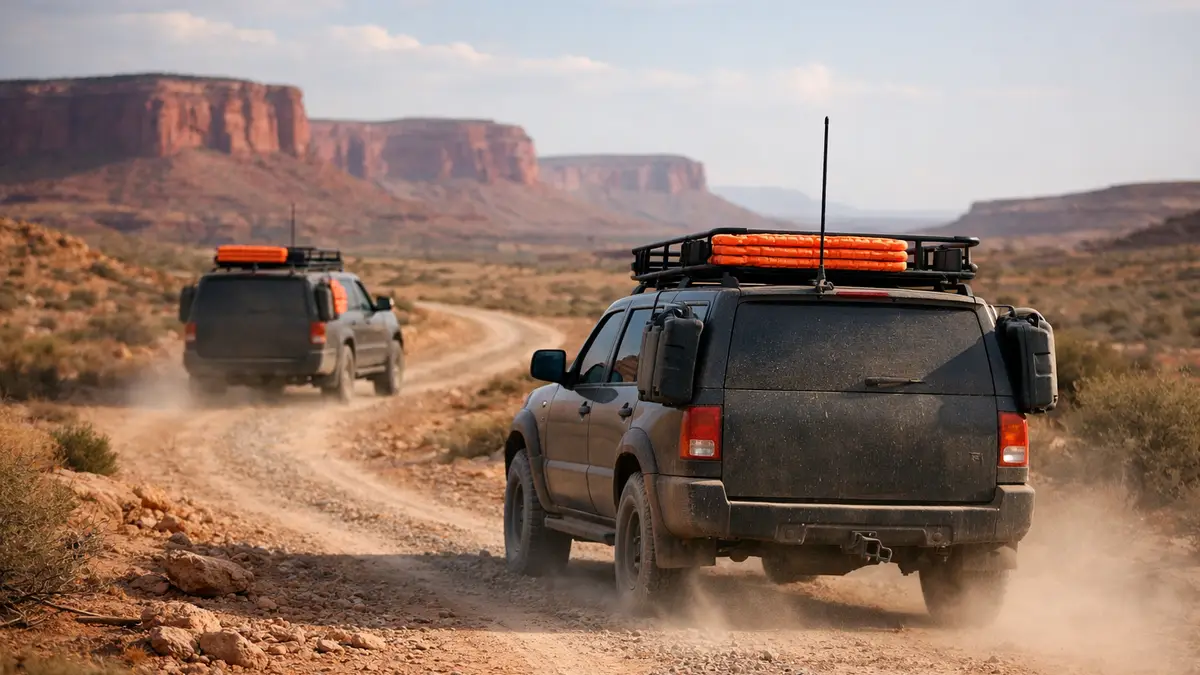
GMRS is the standard off-road and overland radio in the US because it clears the three hurdles CB and ham cannot clear at once: no exam, a license that covers the whole family, and enough power and antenna freedom to talk truck to truck across a convoy. This page covers which radios to run, how to mount them, and how to set up channels for a group drive.
Why do overlanders use GMRS?
GMRS gives overland groups clean UHF audio, up to 50 watts of power, removable antennas and repeater access, with a license that needs no exam and covers your family for $35 over 10 years. That combination is why it has largely replaced CB on US trails.
Compared with ham radio, GMRS needs no test, so every driver in the family can legally key up without studying. Compared with CB, it has clearer audio, smaller antennas and the option to extend range through a repeater. The GMRS radio guide covers the service in full.
What GMRS radio setup should an overland rig run?
Run a mobile radio as the primary station and keep a handheld as backup. A 15 to 50 W mobile with an externally mounted antenna outperforms any handheld by a wide margin, because the antenna sits high on the vehicle and feeds real power.
| Setup | Example | Role |
|---|---|---|
| 15 W mobile | Midland MXT275 | Compact primary radio, hidden install |
| 50 W mobile | Midland MXT575 | Maximum power for spread-out convoys |
| 5 W handheld | Rugged or Midland handheld | Backup, spotting, out-of-truck use |
| External antenna | Roof, hood or rack mount | The real range upgrade |
The best GMRS mobile radios page compares mobile units, and the GMRS antenna guide covers gain and mounting.
How far will GMRS reach on the trail?
Between two 50 W mobiles with roof antennas, expect about 2 to 5 miles over rolling, lightly wooded ground, dropping in tight canyons and dense forest. Within a convoy, where trucks are spaced a few hundred yards apart, GMRS is reliable even in rough terrain.
These figures come from our walkie-talkie range calculator. Two handhelds alone manage roughly 0.5 miles in the same terrain, which is why the mobile and its roof antenna matter so much for a spread-out group.
Where should you mount a GMRS antenna on an off-road vehicle?
Mount the antenna as high and as clear of metal as the rig allows, since ground-plane and height drive performance. Common off-road mounts are a roof rack, a hood channel, a fender, or a bed rail on a pickup.
A roof or rack mount gives the best pattern but needs clearance for garages and trail branches; a fold-over or spring base helps on brush-heavy trails. Avoid mounting low behind a roll cage or large metal panel, which blocks the signal. The antenna guide details ground planes, gain and cable loss for vehicle installs.
What channel should an overland convoy use?
Agree on a channel and privacy code at the trailhead before you move. There is no single official trail channel, though many groups default to channel 16 or a club’s standard. Pick one, confirm everyone is on the same privacy code, and do a radio check before the first obstacle.
Keep traffic short and clear: lead vehicle calls obstacles, tail vehicle confirms the group is together. The channels and frequencies chart lists each channel and its power limit so you avoid the low-power channels 8 to 14 for convoy work.
Who is GMRS overlanding not right for?
GMRS is not the answer for every off-road situation:
- Solo travel in true backcountry. If there is no one else in range and no repeater, GMRS cannot reach a town over the horizon. Carry a satellite messenger for emergencies.
- International overland trips. A US GMRS license does not authorize use in Canada, Mexico or beyond; each country has its own rules.
- Groups that want regional range. If you need to reach far beyond a convoy, ham radio with its wider repeater networks fits better, at the cost of an exam.
What accessories improve a GMRS overland setup?
A few additions matter more than a higher-power radio:
- A good external antenna and mount. This is the real range upgrade; see the antenna guide.
- An external speaker or a quality hand mic, so you can hear over engine and tire noise.
- A spring or fold-over antenna base, which saves the antenna on low branches and garage entries.
- An SWR meter, to confirm the antenna is tuned before a long trip; the how to check SWR guide covers it.
- A backup handheld per vehicle, for spotting and for use away from the truck.
Is GMRS or ham radio better for overlanding?
GMRS wins for most overland groups because it needs no exam and one license covers the family. Ham radio reaches farther through larger repeater networks and more bands, but every operator must pass a test, which is a barrier for a casual family convoy.
Many serious overlanders eventually hold both: GMRS for the group and ham for long-distance or emergency reach. If your trips stay within a convoy and occasional repeater range, GMRS alone is usually enough. Weigh the trade-offs in GMRS vs ham radio.
What does a GMRS overland setup cost?
A capable single-vehicle setup runs about $200 to $560 plus the $35 license, depending on the radio and antenna.
| Item | Example | Typical price |
|---|---|---|
| FCC license | 10 years, whole family | $35 |
| 15 W mobile radio | Midland MXT275 | about $200 |
| 50 W mobile radio | Midland MXT575 | about $440 |
| External antenna and mount | Roof or rack whip | $40 to $120 |
| Backup handheld | 5 W GMRS | $25 to $220 |
Prices are representative US figures as of October 2026; the best GMRS mobile radios page has current comparisons. There is no subscription or monthly fee on GMRS.
How should a convoy handle radio traffic?
Keep a simple discipline so the channel stays useful. The lead vehicle calls turns, obstacles and hazards; the tail vehicle confirms the group is still together after each. Everyone else stays off the air unless they have something the group needs.
Use short, clear calls: position, then message, then release. Agree on a backup channel in case your primary is busy or has interference. For the full channel list and power limits, see the channels and frequencies chart.
How do you get set up for a first trip?
Get the GMRS license first, since it covers your family and takes a few minutes online. Install a mobile radio and a roof or rack antenna in the primary rig, keep a handheld as backup, and run the numbers for your terrain in the range calculator. Then agree on a channel with your group and do a radio check before you hit the trail.
Frequently asked questions
Quick answers to what readers ask us most
Do I need a license for GMRS while overlanding?
Yes, to transmit. The FCC GMRS license costs $35, needs no exam, lasts 10 years and covers your immediate family. Everyone in your own vehicle is covered by your license, but each separate family or driver needs their own. See our license walkthrough.
What GMRS channel do overlanders use?
There is no single official trail channel, but many groups default to channel 16 or agree on one before the drive. Always confirm the channel and any privacy code with your convoy at the trailhead rather than assuming.
Is GMRS better than CB for off-road?
For most overlanders, yes. GMRS runs clearer UHF audio, supports repeaters, and the radios and antennas are smaller than CB gear. CB needs no license but has noisier AM audio and bulkier antennas. See our GMRS vs CB comparison for the trade-offs.
How far will GMRS reach between trucks in a convoy?
With 50 W mobiles and roof antennas, expect about 2 to 5 miles over rolling terrain and less in tight canyons or heavy forest. Within a convoy spaced a few hundred yards apart, GMRS is reliable.