
GMRS vs Ham Radio: Which License and Radio Fit Your Use
GMRS costs $35 for 10 years with no exam and covers your family. Ham radio needs an exam but opens more bands, power and gear. How to choose, rule by rule.
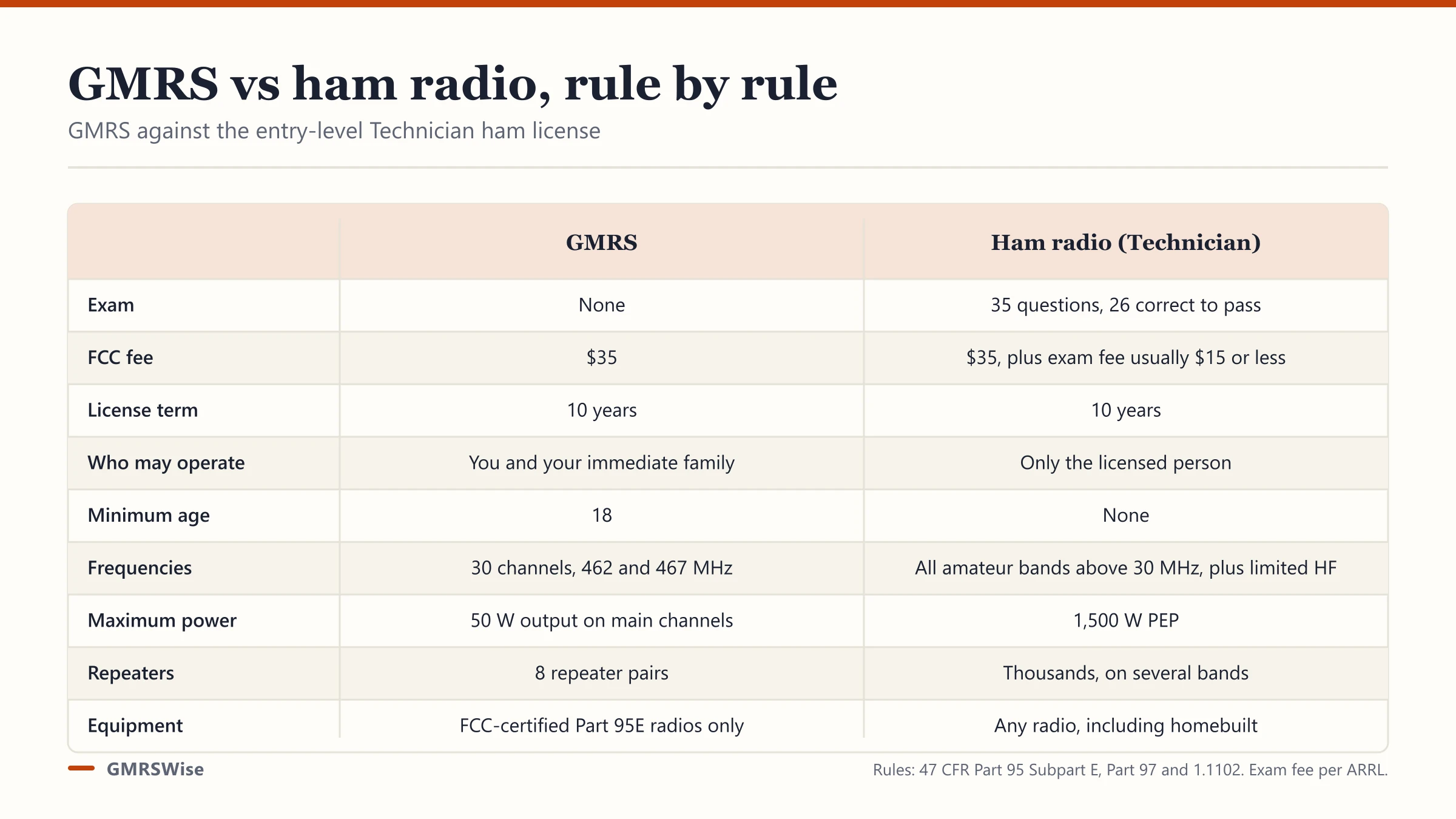
GMRS and ham radio both need an FCC license, both cost $35, and both last 10 years. The similarities stop there. One is a family radio service with fixed channels and no exam. The other is a technical hobby with an exam, dozens of bands and far fewer limits on what you can build and buy.
What is the difference between GMRS and ham radio?
GMRS (General Mobile Radio Service) is a personal radio service under 47 CFR Part 95 Subpart E: 30 fixed channels near 462 and 467 MHz, no exam, and one license that your immediate family can use. Ham radio (the Amateur Radio Service) is governed by 47 CFR Part 97: dozens of bands from long wave up into the microwave range, an exam for every operator, and up to 1,500 W of power.
In practice, GMRS is for talking to your own group: the family on a road trip, the off-road convoy, the hunting camp. Ham radio is for people who want to experiment, reach across a region or the world, and pick their own equipment. Our GMRS radio guide covers the GMRS side in more depth.
How do GMRS and ham radio compare, rule by rule?
GMRS trades flexibility for simplicity: no exam and family coverage, but fixed channels, certified radios only and a 50 W ceiling. Ham radio asks for an exam from every operator and gives back dozens of bands, 1,500 W and the freedom to use any equipment. The table sets the main rules side by side, with the section of the rule that sets each one.
| GMRS | Ham radio (Technician) | |
|---|---|---|
| Exam | None | 35 questions, 26 correct to pass (97.503) |
| FCC fee | $35 (47 CFR 1.1102) | $35, plus exam fee usually $15 or less |
| License term | 10 years | 10 years |
| Who may operate | You and your immediate family (95.1705) | Only the licensed person |
| Minimum age to apply | 18 | None |
| Frequencies | 30 channels, 462 and 467 MHz | All amateur bands above 30 MHz, plus limited HF |
| Maximum power | 50 W output on main channels; 5 W ERP on 1-7; 0.5 W ERP on 8-14 (95.1767) | 1,500 W PEP; 200 W PEP on Technician HF segments (97.313) |
| Repeaters | 8 repeater pairs | Thousands, on several bands |
| Equipment | FCC-certified Part 95E radios only | Any radio, including homebuilt and modified gear |
| Talk to FRS radios | Yes | No |
Do you need an exam for GMRS or ham radio?
GMRS has no exam. You create an FRN in the FCC’s CORES system, apply in ULS, pay $35 and receive a call sign. Our GMRS license walkthrough goes through every screen.
Ham radio requires passing an exam given by volunteer examiners. The entry level, Technician, is 35 multiple-choice questions drawn from a public pool of 409 questions (the 2026-2030 pool, in use since July 1, 2026), and you need 26 correct. The General exam is also 35 questions with 26 to pass; Amateur Extra is 50 questions with 37 to pass. The FCC still charges $35 after you pass. The full path, with costs and study options, is in how to get a ham radio license.
Who can use the radio under each license?
A GMRS license covers a group; a ham license covers one person. Under 47 CFR 95.1705, the GMRS licensee may let immediate family members operate: spouse, children, grandchildren, stepchildren, parents, grandparents, stepparents, brothers, sisters, aunts, uncles, nieces, nephews and in-laws. One $35 license can put a whole extended family on the air.
A ham license authorizes only the person who passed the exam. If four people in your household want to transmit on ham bands, all four need to pass. Anyone can talk on a ham radio under the direct supervision of a licensed control operator, but that does not work for a family spread across three vehicles. This single rule decides the question for most families.
Which one has more range?
Ham radio has more ways to reach far, but on the same handheld the difference is smaller than people expect. Our walkie-talkie range calculator puts two 5 W handhelds at head height over open rolling ground:
| Scenario (5 W handhelds, both at 5 ft) | Reliable to best-case range |
|---|---|
| GMRS handheld, 462 MHz, rolling open ground | 1.0 to 1.7 miles |
| Ham 2 m handheld, 146 MHz, rolling open ground | 1.3 to 2.3 miles |
| GMRS handheld, hills with light trees | 0.3 to 0.6 miles |
| Ham 2 m handheld, hills with light trees | 0.7 to 1.2 miles |
The 2 m band bends around hills and trees a little better. The real range gap comes from infrastructure: ham operators can use thousands of repeaters, internet-linked systems such as EchoLink and AllStarLink, and HF bands that bounce off the ionosphere. GMRS has 8 repeater pairs, and the FCC’s GMRS guidance says its repeaters may not be linked over the internet (47 CFR 95.1733(a)(8) and 95.1749). See GMRS repeaters for what that network can do.
Can you use a Baofeng or other ham radio on GMRS?
Not legally. Under 47 CFR 95.1761(c), the FCC will not certify a GMRS radio that can also transmit in a service without equipment certification, such as the amateur service. A radio that covers ham bands is therefore not a legal GMRS radio, even if it can be programmed to 462 MHz. The classic Baofeng UV-5R is a ham radio: a licensed ham may use it on ham bands, and nobody may use it on GMRS.
The reverse also holds. A GMRS-certified radio has its frequencies locked to the 30 GMRS channels, so it cannot be used on ham bands. Our Baofeng and GMRS guide lists which Baofeng models carry Part 95E certification.
What does each one cost to get started?
The license cost is close; the per-family cost is not. GMRS: $35 once every 10 years, for the whole family, plus radios. Ham: $35 to the FCC and an exam fee that the ARRL says is usually $15 or less, per person, plus study time and radios.
| Household | GMRS license cost | Ham license cost (exam at $15) |
|---|---|---|
| 1 person | $35 | $50 |
| Couple | $35 | $100 |
| Family of 4 | $35 | Up to $200, and every child must pass the exam |
The ARRL says it covers the one-time $35 FCC fee for new license candidates under 18, which lowers the ham figure for children but does not remove the exam.
Radio prices overlap. Entry ham handhelds are cheap partly because amateur radios need no FCC equipment certification; certified GMRS handhelds often cost more for comparable features. Our best GMRS radios list shows current prices with the month they were checked.
Where does CB radio fit?
CB is the third option, and it needs no license at all. Citizens Band uses 40 channels between 26.965 and 27.405 MHz, with 4 W carrier power on AM and 12 W peak envelope power on single sideband (47 CFR 95.967). Channel 9 is reserved for emergencies and traveler assistance.
CB suits truckers and some off-road clubs that already use it, and its 27 MHz signal sometimes skips hundreds of miles when the ionosphere cooperates. The downsides are long antennas (a full-size CB whip is over 8 feet), noise, and no repeaters. Ham radio’s 10 m band (28.0 to 29.7 MHz) sits just above CB and allows far more power and more modes. For a family that just wants clear voice between vehicles, GMRS is usually the better fit than CB.
Which should you choose?
Match the license to who needs to talk and how far.
- Choose GMRS if you need a family or a small group on the air this month, no one wants to study, and your range needs are a few miles plus a local repeater.
- Choose ham radio if you enjoy the technical side, want to reach beyond the next valley through repeaters and HF, or want to program and build your own equipment.
- Get both if you are the person in the group who wants range and flexibility, while the rest of the family stays on GMRS. Many off-road and prepper groups work this way.
- Stay with FRS if you only need a mile or two between people who can see each other. No license is needed; see GMRS vs FRS.
Who is this comparison not for?
This page covers US rules only. GMRS is an FCC service; Europe and many other countries use PMR446 for license-free radio, and each country runs its own amateur exam. It is also not for businesses running a fleet: they need business radio licensing under Part 90 through a dealer, not GMRS or ham. And if you already hold a General or Extra class license, you know the ham side better than this summary.
Where do these numbers come from?
Rules: 47 CFR Part 95 Subpart E (GMRS), Part 95 Subpart D (CB) and Part 97 (amateur), current eCFR text checked October 2026. Fees: 47 CFR 1.1102. Exam fee: ARRL’s “what to bring to an exam session” page. Question pool: NCVEC 2026-2030 Technician pool, effective July 1, 2026 to June 30, 2030. Range: the GMRSWise range model (radio horizon plus the Egli propagation model), with every assumption listed on the calculator page.
Frequently asked questions
Quick answers to what readers ask us most
Is GMRS or ham radio better for emergencies?
For a family, GMRS is usually the practical pick: no exam, everyone in the family can use it, and FRS radios can talk to you. Ham radio reaches farther through repeater networks and HF, but every operator needs their own license.
Can a ham radio operator use a ham radio on GMRS?
No. A ham license does not cover GMRS, and ham radios are not certified for GMRS. Under 47 CFR 95.1761 the FCC will not certify a GMRS radio that can also transmit in the amateur service. You need a GMRS license and a Part 95E radio.
Do I need a license for both GMRS and ham radio?
Yes, if you want to transmit on both. They are separate FCC licenses with separate call signs. Each costs $35 and runs 10 years. Ham requires an exam; GMRS does not.
Can GMRS radios talk to ham radios?
Not legally. 47 CFR 95.1733 bars GMRS stations from communicating with Amateur Radio Service stations except in emergencies. The two services also use different frequencies.
Which is cheaper, GMRS or ham radio?
The FCC fee is the same $35 for each. Ham adds an exam session fee, usually $15 or less, and covers only one person. GMRS covers your immediate family under one license, so for a family of four GMRS is far cheaper.