
Nationwide Walkie-Talkies: Cellular PTT vs Satellite
Nationwide walkie-talkies compared: push-to-talk over cellular radios, PTT apps and satellite messengers on coverage, fees, delay and no-signal use.
A walkie-talkie that reaches across a state or the whole country is not a radio in the FRS or GMRS sense. FRS and GMRS are line-of-sight UHF services that cover a few miles between handhelds. Products sold as nationwide walkie-talkies send your voice over cell networks, and products sold as satellite walkie-talkies are mostly satellite text messengers. This page compares what each one actually does, with October 2026 prices.
What is a nationwide walkie-talkie?
A nationwide walkie-talkie is a push-to-talk over cellular (PoC) device: a radio-shaped handset with a SIM card that sends voice as data over LTE networks to a server, which passes it to everyone in your talk group. It works like a walkie-talkie (press, talk, release) but depends entirely on cell coverage.
Because the carrier holds the spectrum license, the user needs no FCC license. The trade-offs are a service fee, a short delay between pressing the button and being heard, and no service where the cell network is weak or down. The radio-only answer to “how far can a walkie-talkie go” is on our long-range walkie-talkie guide.
How do the nationwide options compare?
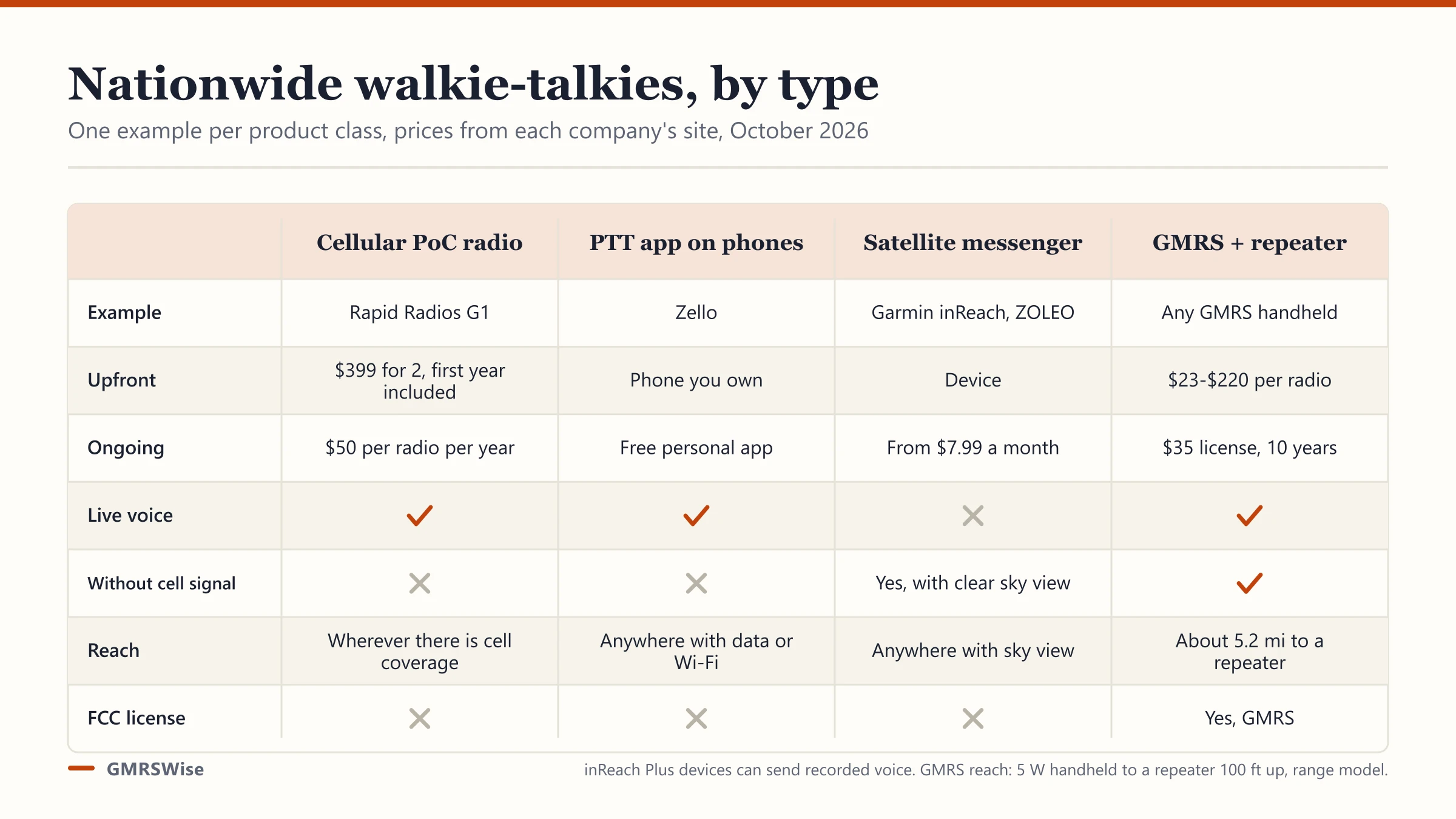
The table compares one example from each product class. Prices and terms come from each company’s own site, checked October 2026.
| Option | Example | Upfront cost | Ongoing cost | Live voice | Works with no cell signal | Delay | FCC license |
|---|---|---|---|---|---|---|---|
| PoC radio, consumer | Rapid Radios G1 | $399 for 2 (first year included) | $50 per radio per year ($40 auto-pay) | Yes | No | Not published | No |
| PoC radio, business | PeakPTT | Radios from $129 | $24.95 per radio per month | Yes | No | About 1 second or less (PeakPTT) | No |
| PTT app on phones | Zello | Phone you own | Free personal app; business from $6.80 per user per month (yearly) | Yes | No (needs data or Wi-Fi) | Network dependent | No |
| Satellite messenger | Garmin inReach | Device | Plans from $7.99 per month | No (text; recorded voice on inReach Plus devices) | Yes, with clear sky view | Not live (messages queue) | No |
| Satellite messenger | ZOLEO | Device plus $19.99 activation | $19.99 or $34.99 per month, 3-month minimum | No (text) | Yes, with clear sky view | Not live (messages queue) | No |
| GMRS radio plus repeater | Any GMRS handheld | $23 to $220 per radio | $35 license, 10 years | Yes | Yes | None | Yes, GMRS |
Satellite messengers queue each message and send it when a satellite is in view, so they never hold a live channel open the way a radio does. The GMRS radio prices span the Baofeng GM-15 Pro to the Midland GXT67 Pro.
Which nationwide walkie-talkie should a family buy?
For a family spread across the country, a consumer PoC radio such as the Rapid Radios G1 is the closest thing to a nationwide walkie-talkie. It costs $399 for a 2-pack with the first year of service, then $50 per radio per year, or $40 on auto-pay. Rapid Radios says it uses multi-carrier SIMs that connect to Verizon, AT&T or T-Mobile, supports private calls and group talk for up to 200 users, and needs no FCC license.
If everyone already carries a smartphone, Zello’s free personal app does the same job over the phones’ data plans. A PoC radio’s advantage is a dedicated push-to-talk button and a simpler device for kids and older relatives.
Not for: anyone who expects it to work in the backcountry, at sea or after a disaster that takes cell towers down.
Which option fits a business fleet?
For crews and fleets, a business PoC provider adds dispatch, GPS tracking and support. PeakPTT, which sells only to businesses and government, charges $24.95 per radio per month for unlimited nationwide push-to-talk on major US carriers, with radios from $129 (PTT-284G) to $259 (PTT-324G), a PC dispatch seat at $12 per month and a phone app user at $9.95 per month.
PeakPTT quotes a talk delay of about 1 second or less. That is fine for dispatch but slower than a direct radio. A crew working inside one site, such as a warehouse or a jobsite, often does better with license-free FRS or licensed business radios, which have no monthly fee; our Motorola walkie-talkie page covers that choice.
Is there a real satellite walkie-talkie?
Not for consumers at walkie-talkie prices. The satellite devices hikers buy are two-way messengers. Garmin inReach plans start at $7.99 per month (Enabled plan, $0.50 per text) and include SOS; inReach Plus devices can also send recorded voice messages, which are clips you send and receive, not a live conversation. ZOLEO plans cost $19.99 per month for 50 messages or $34.99 for unlimited, with a $19.99 activation fee and a 3-month minimum.
Live push-to-talk over satellite does exist: Iridium offers a satellite push-to-talk service for government and business users, sold through its service partners. We could not verify current device or service pricing, so we do not quote any. For a family or a hiking group, a satellite messenger for emergencies plus local radios for talking is the realistic setup.
Do cellular walkie-talkies work in an emergency?
Only while the cell data network works. A PoC radio sends voice as data through towers and servers, so if towers lose power, are damaged or are overloaded, the radio stops working with them. Rapid Radios advertises that its RAD1 model switches to Wi-Fi when cellular fails, which still needs a working internet connection.
For communication that depends on no infrastructure, use radios that talk directly: FRS or GMRS between family members, or ham radio for longer distances with a license. A GMRS repeater adds range but needs its own power at the repeater site, so ask the owner whether it has backup power. Our GMRS vs ham radio page compares the two services for preparedness.
When is a GMRS radio plus a repeater the better choice?
Choose GMRS when your group is within one region, such as a town, a ranch, a ski area or a stretch of trail, and you want instant voice with no monthly fee and no dependence on cell towers. In our range calculator, a 5 W GMRS handheld reaches a repeater 100 ft up about 5.2 miles away reliably over rolling, lightly wooded ground, and up to about 9 miles in good conditions.
That covers a town, not a state. A GMRS license costs $35 for 10 years and covers your immediate family; see our GMRS license guide. Public repeaters near you are listed on directories such as myGMRS, and our GMRS repeater guide explains how to get permission and program one.
Can ham radio reach across the country?
Yes, with a license and the right setup. Licensed hams talk across the US through internet-linked repeater systems such as EchoLink, Yaesu WIRES-X and D-STAR reflectors, using an ordinary handheld to reach a local repeater, and over long distances on the HF bands with a General license.
This is a hobby with an exam, not a product you buy and switch on. If it interests you, start with the Technician license and a dual-band handheld; our best handheld ham radios page compares the first radios most new hams buy.
Who should not buy a nationwide walkie-talkie?
Three groups should buy something else:
- Backcountry travelers beyond cell coverage: a PoC radio becomes a paperweight there. Carry GMRS or FRS radios for talking and a satellite messenger or personal locator beacon for SOS.
- Groups that stay within a few miles, such as a campground, a ski hill or a jobsite: license-free FRS radios do this with no fee and no delay.
- Anyone who needs guaranteed emergency communication: no single system is guaranteed, and cellular systems fail when the network does.
How we checked these options
We did not field-test these devices. Product details, prices and plan terms come from rapidradios.com, peakptt.com, zello.com, garmin.com and zoleo.com, read in October 2026; claims such as carrier coverage, group size and Wi-Fi fallback are the makers’ own. Iridium’s push-to-talk service is named without pricing because we could not verify it. GMRS repeater range comes from our calculator’s Egli-based model, not from field tests.
Frequently asked questions
Quick answers to what readers ask us most
Is there a walkie-talkie that works anywhere in the US?
Push-to-talk over cellular radios work anywhere their cell networks have LTE data coverage, which covers most populated areas but not much backcountry. No license-free radio-only walkie-talkie reaches across a state.
Do nationwide walkie-talkies have monthly fees?
They all have some service fee. Rapid Radios includes the first year, then charges $50 per radio per year ($40 on auto-pay). PeakPTT, a business provider, charges $24.95 per radio per month. Prices checked October 2026.
Is there a satellite walkie-talkie for live voice?
Not for consumers at walkie-talkie prices. Garmin inReach and ZOLEO messengers send texts, and inReach Plus devices also send recorded voice messages. Live satellite push-to-talk exists as a business and government service on Iridium.
Do I need an FCC license for a cellular walkie-talkie?
No. Push-to-talk over cellular radios use the carriers' licensed networks, so the user needs no license. Rapid Radios states that no FCC license is needed.
Do cellular walkie-talkies work when the cell network is down?
No. They need a working cell data connection. Rapid Radios says its RAD1 falls back to Wi-Fi, which still needs a working internet connection. For no-infrastructure communication, use GMRS or ham radios.