
Best Long-Range Walkie-Talkies, and What Range Really Means
What the 36-mile number on the box means, how far walkie-talkies really reach, and the best long-range FRS and GMRS picks of 2026 with October 2026 prices.
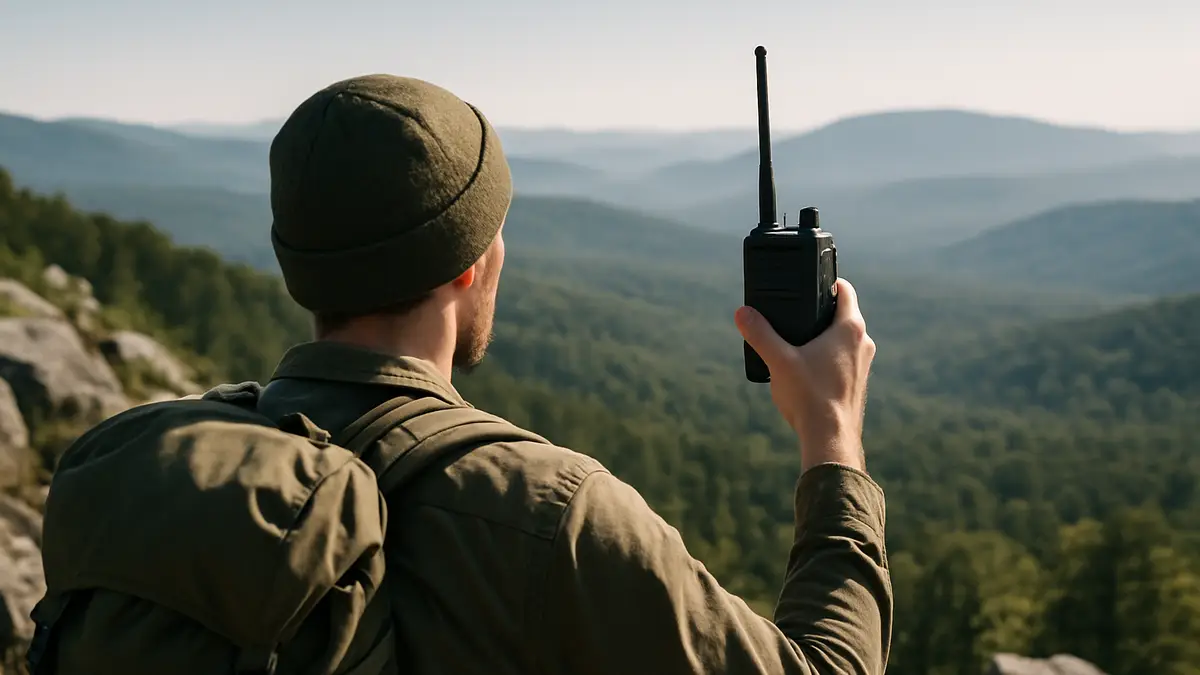
Every walkie-talkie box promises a big number: 25 miles, 36 miles, 38 miles. Then two people try them across a campground and lose each other behind the first stand of trees. This page explains what range numbers really mean, shows what to expect in common places, and then picks the best long-range radios, license-free first, with prices checked on the makers’ stores in October 2026.
What does “36 miles” on the box actually mean?
It means the best case for two radios with a clear line of sight to each other, typically from one high point to another. Midland says this plainly in its own product FAQ: the 36 mile figure assumes perfect conditions such as mountaintop to mountaintop, and its GXT radios average one-half to two miles in normal conditions. Midland’s spec sheets add that maximum range needs open water or open rural land under optimum conditions.
Rocky Talkie publishes a terrain table instead of one number. For its 2 W FRS Mountain Radio, it lists 35+ miles line of sight but 1 to 5 miles in mountains. UHF radio travels in straight lines; hills, trees, buildings and the curve of the Earth stop it.
How far do walkie-talkies really reach?
Between two people standing on the ground, most walkie-talkies reach between a few tenths of a mile and about two miles. These are median estimates from our walkie-talkie range calculator, reliable range to best case:
| Where | FRS pair (2 W) | GMRS handheld pair (5 W) | Two 50 W GMRS mobiles |
|---|---|---|---|
| Rolling ground, light trees | 0.5 to 0.9 mi | 0.6 to 1.1 mi | 2.7 to 4.8 mi |
| Open rolling ground, no trees | 0.8 to 1.4 mi | 1.0 to 1.7 mi | 4.2 to 6.9 mi |
| Suburban neighborhood | 0.4 mi reliable | 0.5 to 1.0 mi | 2.4 mi reliable |
| Hilly, wooded trail | 0.3 mi reliable | 0.3 to 0.6 mi | 1.5 mi reliable |
Two numbers stand out. FRS and GMRS handhelds are close, because 2 W versus 5 W is a small difference in decibels. And vehicle radios with roof antennas are in a different class.
Which long-range walkie-talkie should you buy? The picks at a glance
| Pick | Radio | License | Price (Oct 2026) | Power | Water rating | What the box claims |
|---|---|---|---|---|---|---|
| Best license-free value | Midland T71VP3 X-Talker | None (FRS) | $99.99 per pair | FRS, Hi/Lo | Not listed | Up to 38 miles |
| Best license-free for the backcountry | Rocky Talkie Mountain Radio | None (FRS) | $120 each, $240 pair | 2 W | IP56 | 35+ miles line of sight, 1-5 in mountains |
| Best licensed value | Midland GXT1000VP4 | GMRS | $99.99 per pair | Hi/Med/Lo | JIS4 (splash) | Up to 36 miles |
| Best licensed handheld | Rocky Talkie Expedition Radio | GMRS | $195 each, $390 pair | 5 W | IP67 | 35+ miles line of sight, 2-8 in mountains |
| Most real range | Midland MXT275 vehicle radio | GMRS | $199.99 | 15 W | Not listed | Not a handheld |
Prices from midlandusa.com and rockytalkie.com, checked October 2026. We compared specs and maker documentation; we did not field-test these radios.
Best license-free value: Midland T71VP3 ($99.99 per pair)
The Midland T71VP3 is the best long-range walkie-talkie for families who do not want a license. It is an FRS radio, so anyone can use it, and the pair costs $99.99 with rechargeable packs, a desktop charger and a micro-USB cable. It has 36 channels, 121 privacy codes, NOAA weather alerts and eVOX hands-free operation, and it also runs on 3 AA batteries.
Midland markets it as the “big brother” of its FRS line with up to 38 miles of range, which, as with every box number, assumes a clear line of sight. Midland’s FAQ puts battery life on high power at around 5 hours at a 90/5/5 standby, receive and transmit split, so carry spare AAs on long days.
Not for: multi-day trips without charging, or anyone who wants repeaters or a vehicle radio later.
Best license-free for the backcountry: Rocky Talkie Mountain Radio ($120)
The Rocky Talkie Mountain Radio is the license-free pick for skiers, climbers and hikers. It transmits at 2 watts, the most FRS allows on channels 1-7 and 15-22, is rated IP56 (splash and snow proof, not submersible), and Rocky Talkie rates the battery at 3 to 5 days per charge. It costs $120 each, $240 for a two-radio kit.
The antenna is a 7.5 cm non-removable stub, as the FRS rules require. Rocky Talkie’s own numbers set honest expectations: 35+ miles line of sight, 1 to 5 miles in the mountains.
Not for: buyers who want more than FRS power; that requires the GMRS Expedition model and a license.
Best licensed value: Midland GXT1000VP4 ($99.99 per pair)
The Midland GXT1000VP4 is the cheapest step from FRS into GMRS for a family. The pair costs the same as the T71VP3 but runs on GMRS, with 22 GMRS channels, 28 preset channels, 142 privacy codes, high, medium and low power, NOAA alerts, and NiMH packs or 4 AA batteries.
Midland’s FAQ is the source of the “one-half to two miles in normal conditions” line quoted above, so expect a modest gain over FRS, not a leap. We found no repeater channels in Midland’s spec list for this model.
Not for: unlicensed users (it needs the FCC GMRS license) or anyone planning to use repeaters.
Best licensed handheld: Rocky Talkie Expedition Radio ($195)
The Rocky Talkie Expedition Radio is the long-range handheld to buy if you are getting a GMRS license anyway. It transmits at 5 watts, is IP67 rated, and has a removable SMA antenna with a 7.5 cm and a 17 cm option in the box. It supports the 8 GMRS repeater channels, which is where the real range gain lives.
Rocky Talkie’s own table lists 2 to 8 miles in mountains, 0.5 to 5 miles in forest and hills, and up to 1.5 miles in a city. Our full handheld comparison, including Midland, BTECH and Baofeng models, is on the best GMRS radios page.
Not for: casual family use, where a $99.99 pair does the same job on short trips.
What is the longest-range walkie-talkie you can buy?
The longest-range “walkie-talkie” is not a handheld. It is a GMRS vehicle radio with a roof antenna, or any GMRS radio working through a repeater. In our calculator, two 50 W mobiles over rolling, lightly wooded ground reach about 2.7 miles reliably, against 0.6 miles for two handhelds. A 5 W handheld working a repeater 100 ft up reaches 5.2 to 9.2 miles from the tower.
The Midland MXT275 ($199.99) is a 15 watt vehicle radio with a magnet-mount antenna that plugs into a 12 V socket and talks to any FRS or GMRS handheld. Pair one with handhelds and the vehicle becomes the strong station everyone can reach.
Are there walkie-talkies with a 1,000-mile range?
No. FRS and GMRS are line-of-sight UHF services, and no handheld reaches 1,000 miles. Products advertised that way are push-to-talk-over-cellular radios, which work only where there is cell coverage and usually carry a service fee, or satellite devices, which send messages rather than live two-way voice for most consumer models.
If you need contact beyond a few miles with no infrastructure, the honest options are a GMRS repeater network, a ham radio license (which opens long-distance bands), or a satellite messenger. Our GMRS radio guide explains where GMRS stops.
Should you choose FRS or GMRS for range?
Choose FRS if your group stays within about a mile and you want no paperwork. Choose GMRS if you need vehicle radios, a home base, repeaters or a removable antenna; the license is $35 for 10 years with no exam and covers your family. Handheld to handheld, the two are close: 0.8 to 1.4 miles for FRS and 1.0 to 1.7 miles for 5 W GMRS on open rolling ground in our model.
The full rules comparison is in GMRS vs FRS, and the license steps are in our GMRS license guide. Brand-specific lineups are covered on our Midland radios and Motorola walkie-talkies pages.
What actually adds range?
Height adds the most. In our calculator, raising one handheld from 5 ft to 15 ft on rolling ground takes a GMRS pair from 1.0 to 1.7 miles, the same gain as ten times the power on both radios. Standing on a ridge, a rock or a second floor is free.
After height: a repeater (GMRS only), a vehicle radio with a roof antenna (GMRS only), then a better antenna on a handheld that allows one. Fresh batteries help too, since several radios drop to low power when the battery runs down. Extra watts on a handheld help least.
Who this page is not for: business teams (Part 90 business radios), buyers outside the US (look for PMR446 radios, the license-free standard in Europe and many other countries), and anyone who needs guaranteed contact over tens of miles.
Frequently asked questions
Quick answers to what readers ask us most
What is the longest range walkie-talkie?
Among handhelds, licensed 5 W GMRS radios reach slightly farther than 2 W FRS radios. The real range leaders are GMRS vehicle radios with roof antennas and any radio working through a repeater, which can cover 5 to 9 miles or more.
Do 36-mile walkie-talkies really reach 36 miles?
Only with a clear line of sight, such as one radio on a mountaintop and the other on another peak. Midland's own FAQ says its GXT radios average one-half to two miles in normal conditions.
Are there walkie-talkies with a 1,000-mile range?
No handheld radio reaches 1,000 miles. Products sold that way use cellular networks (push-to-talk over cell) or satellites, which need coverage or a subscription. Plain FRS and GMRS radios are line-of-sight UHF.
Do long-range walkie-talkies need a license?
FRS walkie-talkies need no license. GMRS radios, which allow more power, removable antennas and repeaters, need an FCC GMRS license: $35, no exam, 10 years, covering your immediate family.
How can I make my walkie-talkies reach farther?
Get higher. Height beats power: a hilltop, a second-floor window or a roof antenna adds more range than extra watts. With a GMRS license, a repeater adds the most of all.