
Best Handheld Ham Radios for New Technicians in 2026
The best first handheld ham radio for a new Technician: Baofeng, Yaesu, BTECH, Kenwood and Icom compared on bands, digital mode, APRS and October 2026 prices.
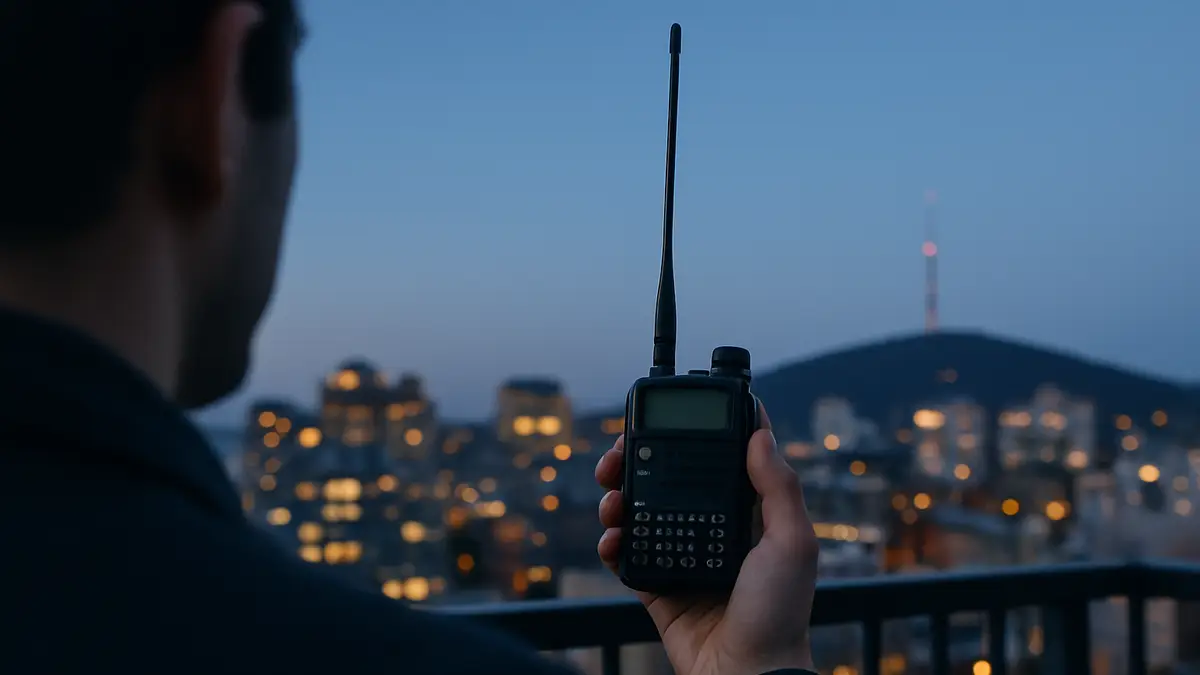
A handheld ham radio, also called an HT, is a battery-powered transceiver for the amateur bands, usually 2 meters (144 to 148 MHz) and 70 centimeters (420 to 450 MHz). The Technician license gives you both bands, so a dual-band handheld is the radio most new hams buy first. This page compares six current models by what a new Technician actually uses: repeaters, simplex, digital voice and APRS.
How we chose. We started from the dual-band handhelds sold by Yaesu, Kenwood, Icom, BTECH and Baofeng in October 2026, checked each maker’s specifications, checked each model against the CHIRP supported-radios list, and took prices from the maker’s own store or, for brands that sell only through dealers, from DX Engineering. We did not field-test these radios.
Which handheld ham radio should you buy? The picks at a glance
| Pick | Radio | Price (Oct 2026) | Bands | Power | Digital | APRS | Water rating | CHIRP |
|---|---|---|---|---|---|---|---|---|
| Cheapest legal start | Baofeng UV-5R | $17.99 sale ($22.99 regular) | 2 m, 70 cm | 5 W | None | No | None listed | Yes |
| Best first “real” radio | Yaesu FT-65R | $119.95 (after $50 instant rebate) | 2 m, 70 cm | 5 / 2.5 / 0.5 W | None | No | IP54 | Yes |
| Best APRS and Bluetooth value | BTECH UV-Pro | $164.89 | 2 m, 70 cm | Up to 7 W peak (BTECH) | None | Yes, built-in GPS | IP67 | No |
| Best digital voice | Yaesu FT5DR | $384.95 (after $100 instant rebate) | 2 m, 70 cm | 5 W | C4FM | Yes | IPX7 | Yes (FT5D) |
| Best all-in-one for hiking | Kenwood TH-D75A | $699.95 (after $50 instant rebate) | 2 m, 1.25 m, 70 cm | 5 / 2 / 0.5 / 0.05 W | D-STAR | Yes, built-in GPS | IP54/55 | Yes |
| Best D-STAR alternative | Icom ID-52A PLUS | $749.95 ($724.95 after $25 mail-in rebate) | 2 m, 70 cm | 5 / 2.5 / 1 / 0.5 / 0.1 W | D-STAR | D-PRS position reports | IPX7 | No |
Prices: Baofeng from baofengradio.com, BTECH from baofengtech.com, Yaesu, Kenwood and Icom from DX Engineering, all checked October 2026. Instant rebates end without notice, so check the current price before you buy.
Is a cheap Baofeng UV-5R legal for ham radio?
Yes, with a ham license and only on amateur frequencies. Amateur transmitters do not need FCC certification; the operator’s license is what makes the transmission legal. The UV-5R’s FCC record (2AJGM-UV5R) is a Part 90 grant covering 136 to 174 MHz and 400 to 480 MHz, which is why it tunes far outside the ham bands and why it is never legal on GMRS.
At $17.99 on sale it is the lowest-risk way to hear your local repeaters and make your first contacts. Its weak points are practical: no published water rating, a keypad menu that is slow to program by hand, and only analog FM. Many owners program it with the free CHIRP software and a $9.99 K-plug cable; our CHIRP programming guide covers that step.
Not for: anyone who wants a radio that survives rain, or who will program channels in the field without a laptop. The GMRS side of the Baofeng story is on our Baofeng and GMRS legality page.
Best first “real” radio: Yaesu FT-65R ($119.95)
The Yaesu FT-65R is the safest first radio for most new Technicians. It transmits at 5, 2.5 or 0.5 watts on 2 m and 70 cm, carries an IP54 dust and water rating and the MIL-810 C, D and E standards, and plays 1 watt of audio through a large front speaker, which matters in wind and traffic.
Yaesu ships it with a 1950 mAh lithium-ion pack rated at over 9 hours, with an optional 2500 mAh pack rated at over 11.5 hours. It is analog FM only, which works on any analog repeater. Programming works from the keypad, from Yaesu’s memory programmer software with the SCU-35 cable, or from CHIRP, which lists the FT-65R. The smaller FT-4XR ($109.95 at DX Engineering after a $40 instant rebate) is the same idea with a 1750 mAh battery.
Not for: operators who want digital voice or APRS.
Best APRS and Bluetooth value: BTECH UV-Pro ($164.89)
The BTECH UV-Pro is the cheapest way into APRS on this list. APRS is the packet system that shares positions and short messages over 2 m. The UV-Pro has GPS built in, works as an APRS station without a phone, and adds a Bluetooth KISS TNC so phone and computer packet apps can use the radio without a cable. BTECH rates it IP67, ships a 2600 mAh USB-C battery, and lists “up to 7W peak output”.
Programming is through BTECH’s phone app or its UV Programmer with CSV import and export, in six banks of 30 channels. The UV-Pro is not on CHIRP’s supported list as of October 2026, and owner reviews on BTECH’s own page ask for it. Its FCC ID is 2AGND-UV-PRO, sold for amateur and Part 90 use, so like every radio here it is not a GMRS radio.
Not for: owners who already manage their radios in CHIRP, or anyone who wants one long channel list instead of banks.
Best digital voice: Yaesu FT5DR ($384.95)
The Yaesu FT5DR is the pick if your local repeaters run Yaesu System Fusion, the C4FM digital mode. It transmits at 5 W on 2 m and 70 cm, is rated IPX7, receives two bands at once (V+V, U+U, V+U), supports APRS, and works with Yaesu’s optional SSM-BT20 Bluetooth headset. With a laptop and the SCU-39 cable kit it can act as a portable WIRES-X node.
Automatic Mode Select switches between C4FM and analog FM on its own, so the radio is still useful on every analog repeater. CHIRP lists the FT5D, and Yaesu’s ADMS-14 software also programs it. The battery is a 2200 mAh SBR-14LI pack. If you want C4FM for less, the FT-70DR was $194.95 at DX Engineering in October 2026.
Not for: areas where the digital repeaters run D-STAR or DMR, because C4FM does not talk to either.
Best all-in-one for hiking: Kenwood TH-D75A ($699.95)
The Kenwood TH-D75A is a tri-band handheld (144, 220 and 430 MHz) that combines D-STAR digital voice, a full APRS station with built-in GPS, Bluetooth, a microSD slot and USB-C charging in one IP54/55 radio. It can act as a standalone APRS digipeater, store 100 APRS stations, and receive SSB and CW on its wideband receiver.
Power steps are 5, 2, 0.5 and 0.05 W, and the supplied battery is 7.4 V, 1820 mAh. CHIRP lists the TH-D75. The 1.25 m band (222 to 225 MHz) is open to Technicians, though most areas have far fewer repeaters there than on 2 m.
Not for: a first radio on a budget. Everything the TH-D75A does, a Technician can grow into later.
Best D-STAR alternative: Icom ID-52A PLUS ($749.95)
The Icom ID-52A PLUS is the other premium D-STAR handheld: 5 W on 2 m and 70 cm with five power steps, IPX7, a 2.3-inch color display with a waterfall band scope, GPS with D-PRS position reporting, 1000 memory channels, a microSD slot and USB-C. Its Bluetooth can link an Android phone for D-STAR Terminal and Access Point modes without a cable.
Icom’s operating-time table lists 7.25 hours in FM with the supplied BP-272 battery and 12 hours with the optional BP-307. The ID-52A PLUS is not on CHIRP’s list; Icom’s own software programs it.
Not for: APRS users who want a native APRS station (pick the TH-D75A), and anyone whose local digital repeaters are C4FM.
Which digital mode should a new ham pick?
Pick the mode your local repeaters use, or none. C4FM, D-STAR and DMR are separate systems; a C4FM radio cannot talk to a D-STAR repeater. Every radio on this page also does analog FM, so each one works on analog repeaters too.
| Mode | Main brands | Radios on this page | Good for |
|---|---|---|---|
| Analog FM | All | All six | Local repeaters, simplex, emergency nets |
| C4FM (System Fusion) | Yaesu | FT5DR | Yaesu repeaters, WIRES-X links |
| D-STAR | Icom, Kenwood | TH-D75A, ID-52A PLUS | D-STAR repeaters and reflectors |
| DMR | Many (BTECH DMR-6X2, AnyTone and others) | None | DMR repeaters and talkgroups |
Look up your area on a repeater directory before you spend $400 on digital. The band and mode privileges for each license class are on our ham radio frequencies chart.
How far will a handheld ham radio reach?
Between two 5 W handhelds standing on the ground, our walkie-talkie range calculator estimates about 1.3 miles reliable (up to 2.3 miles) on 2 m over rolling open ground, and about 1.0 mile (up to 1.7) on 70 cm. In hilly country with light trees the figures drop to about 0.7 miles on 2 m and 0.3 miles on 70 cm.
Repeaters change the picture. In the same model, a 2 m handheld reaches a typical 100 ft, 50 W repeater about 8 miles away reliably over rolling, lightly wooded ground. Ham repeaters work like GMRS ones, with a split transmit and receive frequency and usually a tone: 2 m repeaters typically use a 600 kHz offset and 70 cm repeaters 5 MHz. Our GMRS repeater guide explains offsets and tones in detail.
Which upgrade helps a handheld most?
A better antenna helps most for the money. In our calculator, swapping a stock rubber antenna (modeled at -3 dBi) for a full-size whip (0 dBi) takes a 2 m pair from about 1.3 to 1.8 miles reliable over rolling open ground. Buy aftermarket whips from the maker or an authorized dealer; popular models are widely counterfeited, a problem covered in our ham radio antennas guide.
After the antenna, height wins: standing on a ridge or a second floor adds more than any power setting. If you need real distance from a vehicle or home, a 50 W mobile or base radio is the next step; see our best mobile ham radios.
Can you use a ham handheld on GMRS?
No. Every GMRS transmitter must be certified under Part 95 Subpart E (47 CFR 95.1761), and section 95.1761(c) says the FCC will not certify a GMRS radio that can also transmit on amateur bands. None of the six radios here is GMRS-certified, so none may transmit on GMRS, even if the owner holds a GMRS license.
Licensed hams who also use GMRS with family carry two radios. The licensing differences between the two services are on our GMRS vs ham radio page.
What do you need before you transmit?
You need an FCC amateur license, and the Technician exam is the first step: 35 multiple-choice questions from a public pool, a session fee, and a $35 FCC application fee. Our ham radio license guide walks through the exam and the FCC steps.
Once your call sign appears in the FCC database, program your local repeaters and the 2 m national simplex calling frequency, 146.520 MHz. Identify with your call sign as Part 97 requires.
Who this page is not for: GMRS-only users (see our GMRS handheld comparison instead), unlicensed buyers who only need family radios (FRS needs no license), and buyers outside the US, where band plans, licensing and these prices differ.
How we checked these radios
We did not field-test these radios. Specifications come from yaesu.com, kenwood.com, icomamerica.com, baofengtech.com and baofengradio.com, read in October 2026. Prices come from the maker’s US store (Baofeng, BTECH) or from DX Engineering (Yaesu, Kenwood, Icom), checked October 2026, with rebates named as the retailer showed them. CHIRP support comes from the CHIRP supported-radios list on chirpmyradio.com, checked October 2026. FCC IDs are as printed on the maker pages. Range figures come from our calculator’s Egli-based model, not from field tests.
Frequently asked questions
Quick answers to what readers ask us most
What is the best handheld ham radio for a beginner?
The Yaesu FT-65R: 5 W on 2 m and 70 cm, IP54, a 1950 mAh battery Yaesu rates at over 9 hours, and CHIRP support. It was $119.95 at DX Engineering in October 2026 after a $50 instant rebate.
Is the Baofeng UV-5R a good first ham radio?
It is the cheapest legal way onto 2 m and 70 cm with a Technician license, at $17.99 on Baofeng's store in October 2026. It has no water rating and is hard to program from the keypad, so most owners program it with CHIRP and a cable.
Can I use a ham handheld on GMRS?
No. GMRS transmitters must be certified under Part 95 Subpart E, and 47 CFR 95.1761(c) bars that certification for radios that can also transmit on ham bands. Holding both licenses does not change this.
Do I need a license to own a handheld ham radio?
No. Buying one and listening needs no license. Transmitting on amateur frequencies needs an FCC amateur license; the entry-level Technician license covers 2 m and 70 cm.
Should my first ham radio be digital?
Only if local repeaters use that mode. C4FM (Yaesu), D-STAR (Icom, Kenwood) and DMR do not talk to each other. Check your area's repeater list first; every radio here also does analog FM.
How far can a handheld ham radio reach?
Between two 5 W handhelds on the ground, our range calculator estimates about 1.3 miles reliable on 2 m over rolling open ground. Through a 100 ft repeater, a 2 m handheld reaches about 8 miles reliably in the same model.