
Longest Range Two-Way Radio: What Reaches Farthest
The longest range two-way radio is not a handheld. How GMRS, ham, CB and satellite messengers compare on real range, and which reaches farthest for your use.
The longest range two-way radio is not a single product, and it is almost never a handheld on its own. Real maximum range comes from the right radio type working through height: a repeater, a vehicle antenna on a hill, or a satellite overhead. This page ranks the options by how far they actually reach, so you can match the service to the distance you need.
What is the longest range two-way radio?
By practical reach, the order is satellite messenger, then ham radio, then GMRS, then CB, then license-free FRS. Satellite messengers send two-way text almost anywhere on Earth with no line of sight. Ham and GMRS repeaters give the longest terrestrial voice range, a radius of several to tens of miles. A plain handheld with no repeater is last, limited to line of sight.
The key fact: distance comes from height and infrastructure, not from the radio in your hand. Any handheld’s advertised mileage assumes a clear line of sight that rarely exists on the ground.
Which radio type reaches farthest?
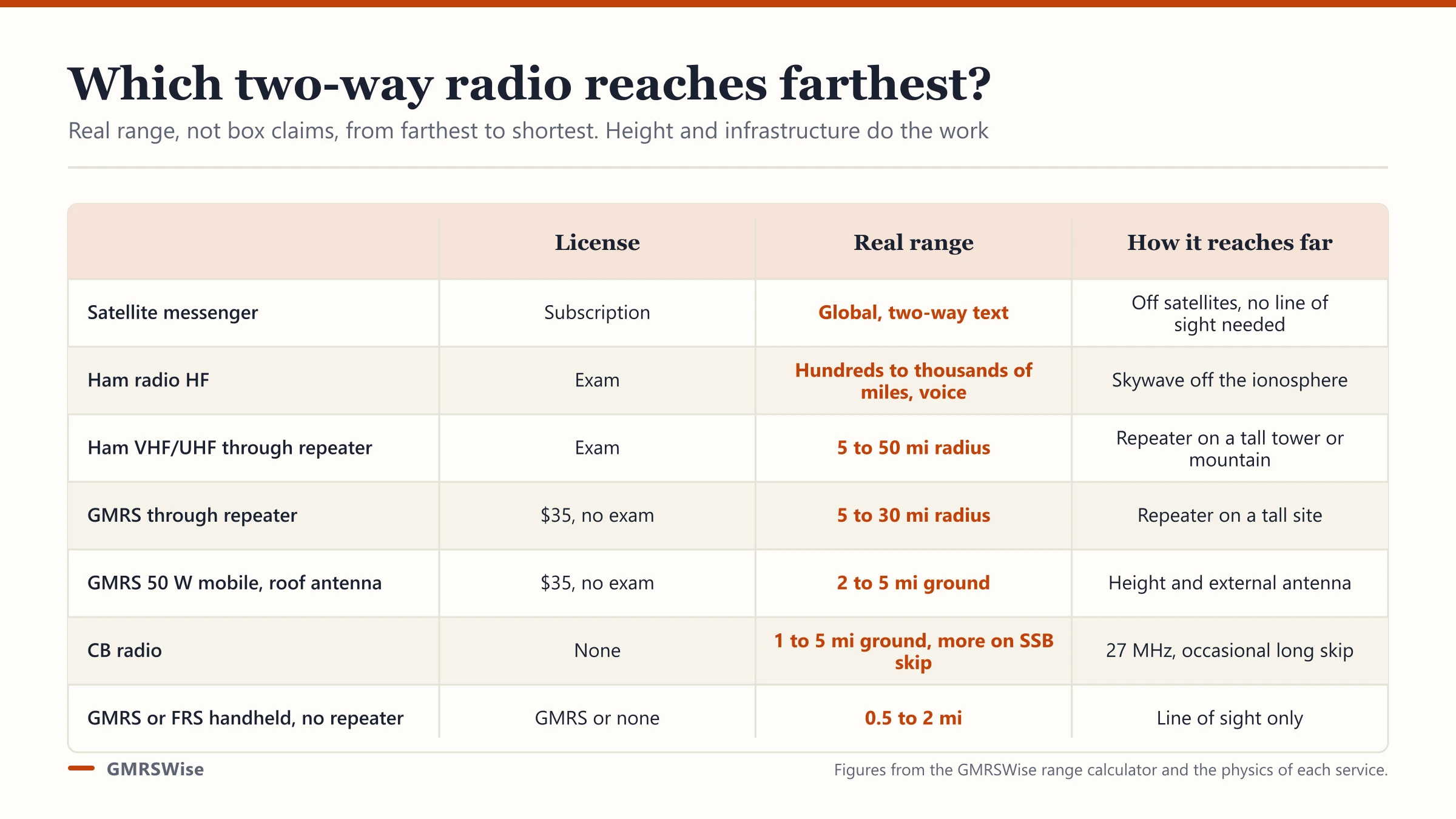
This table compares the main two-way options by real-world range, not box claims. Figures are typical ranges from our walkie-talkie range calculator and the physics of each service.
| Radio type | License | Real range | How it reaches far |
|---|---|---|---|
| Satellite messenger (inReach, ZOLEO) | Subscription | Global, two-way text | Bounces off satellites, no line of sight needed |
| Ham radio HF | Exam | Hundreds to thousands of miles (voice) | Skywave bounces off the ionosphere |
| Ham radio VHF/UHF through repeater | Exam | 5 to 50 mi radius | Repeater on a tall tower or mountain |
| GMRS through repeater | $35, no exam | 5 to 30 mi radius | Repeater on a tall site |
| GMRS 50 W mobile, roof antenna | $35, no exam | 2 to 5 mi ground | Height and external antenna |
| CB radio | None | 1 to 5 mi ground, more on SSB skip | 27 MHz, occasional long skip |
| GMRS or FRS handheld, no repeater | GMRS or none | 0.5 to 2 mi | Line of sight only |
What is the longest range handheld radio?
A handheld’s own range is short, so the longest-reaching handheld is the one that can use a repeater. A 5 W GMRS or ham handheld that hits a repeater on a mountain can be heard across a radius of 5 to 30 miles, even though the same radio reaches under 2 miles talking directly to another handheld.
For true distance with no infrastructure, the longest-range handheld device is a satellite messenger, which sends and receives text worldwide. It is not a push-to-talk voice radio, but it is the only handheld that ignores terrain and distance entirely.
Best long-range two-way radio by use
The right pick depends on who you are talking to and where:
- Family and group within a few miles: a licensed GMRS setup. Use 5 W handhelds for people on foot and a 50 W mobile as the strong station. See best GMRS mobile radios.
- Regional voice range, willing to study: ham radio, which adds more bands, power and repeater networks. Weigh it in GMRS vs ham radio.
- Backcountry with no one else in range: a satellite messenger for two-way text and SOS, since no local radio reaches a town over the horizon.
- License-free and simple: FRS walkie-talkies, accepting 0.5 to 2 miles. Our best long-range walkie-talkies page ranks the consumer models.
Why does a repeater beat a more powerful radio?
A repeater sits high and relays both sides of a conversation, so two low radios that cannot hear each other can both reach the tower. Height extends line of sight; a repeater 100 feet up sees far past anything two handhelds at chest level can.
That is why a modest 5 W handheld through a repeater outranges a 50 W mobile talking directly. The GMRS repeater guide explains how to find a repeater and get permission to use it. Raw watts help only over open ground, and far less than height does.
What sets the maximum range of a radio?
The hard limit for line-of-sight radio is the radio horizon, which grows with antenna height. Two antennas a few feet off the ground can only see each other for a few miles before the earth curves away; raise one onto a tower or mountain and the horizon jumps to tens of miles.
This is why no amount of power turns a ground-level handheld into a long-range radio. Power pushes a signal along the path it can take, but it cannot bend the signal over the horizon or through a ridge. Height, and the infrastructure that provides it, is the real lever. The walkie-talkie range calculator models this directly.
How do linked repeaters extend GMRS range?
Some GMRS repeaters are linked together, so a signal into one repeater is rebroadcast from others in the network, covering a region far larger than any single site. A handheld in one valley can be heard across linked sites dozens of miles apart.
Local clubs run many of these networks, and access is at the owner’s discretion, so ask before using one. The GMRS repeater guide covers finding networks and getting permission. A linked repeater system is the longest terrestrial range most GMRS users will ever reach.
Where do MURS and marine radios fit?
Two other lightly regulated services come up in long-range searches, but neither beats a GMRS repeater for distance. MURS is a license-free VHF service capped at 2 watts on five channels, with no repeaters allowed. In our model it ties FRS on flat open ground and reaches farther on rolling or wooded land. Marine VHF handhelds reach well over open water, where nothing blocks them, but are meant for use on the water, not general land use.
For land use by a family or group, GMRS with a repeater remains the practical long-range choice among the license-light services. Ham radio and satellite messengers are the only steps up from there.
Does a bigger antenna beat a more expensive radio?
Yes, almost always. Spending on a better external antenna and getting it higher returns more range than buying a premium radio at the same power. A modest radio on a tall gain antenna outperforms a top-tier handheld held at chest level.
For a fixed location that means a base antenna on a mast; for a vehicle, a proper roof or rack mount; for a person on foot, the only real upgrade is reaching a repeater. The best GMRS mobile radios page and the range calculator show the difference height makes.
What about 1,000-mile or satellite radios?
Products advertised with huge ranges are usually not radios in the traditional sense. A “1,000-mile” two-way device runs over the cellular network (push-to-talk over cell) and needs coverage and a subscription, so it fails exactly where you would want it, off the grid.
Genuine long distance off grid means either ham HF, where skywave can span continents when conditions allow, or a satellite messenger for worldwide text. Neither is a simple handheld you buy and talk on at once. For most families, a GMRS repeater is the realistic long-range answer; start with the GMRS radio guide to set it up.
Frequently asked questions
Quick answers to what readers ask us most
What is the longest range handheld two-way radio?
On its own, a handheld is limited to line of sight, usually 0.5 to 2 miles on the ground. The longest real reach comes from a 5 W GMRS or ham handheld used through a repeater, which can cover a radius of 5 to 30 miles depending on the repeater's height.
Is GMRS or ham radio longer range?
Ham radio can reach farther because it has more bands, more power and larger repeater networks, and HF bands can span continents. For simple family use, a GMRS repeater often gives similar practical range with no exam. See our GMRS vs ham radio comparison.
What radio has the longest range of all?
For two-way text with no distance limit, a satellite messenger such as a Garmin inReach reaches almost anywhere on Earth. For voice, ham HF can span thousands of miles under good conditions. Neither is a simple push-to-talk handheld.
Are 50-mile two-way radios real?
Only line of sight. A 50-mile figure assumes one radio high on a mountain with a clear view. On the ground between people, expect a few miles at most without a repeater.