
How to Get a Ham Radio License: Exam, Cost, Timeline
The US ham radio license path step by step: FRN, the 35-question Technician exam, where to test, the $35 FCC fee plus exam fee, and what you can do next.
A US ham radio license takes one exam, two fees and a few weeks of study. There is no Morse code test, no minimum age, and the questions are published in advance. This guide covers the entry-level Technician license, which is where nearly everyone starts, and the path from there.
What are the steps to get a ham radio license?
- Get an FRN. Register in the FCC’s CORES system for a free FCC Registration Number. Exam teams need it on your application.
- Study the question pool. The Technician exam draws from a public pool of 409 questions, with the correct answers published.
- Find an exam session. Volunteer examiner (VE) teams accredited by a Volunteer Examiner Coordinator (VEC) run sessions in person and, for some teams, online.
- Pass the exam. 35 multiple-choice questions; 26 correct passes (47 CFR 97.503).
- Pay the FCC. The FCC emails a payment link; pay the $35 fee in CORES within 10 calendar days.
- Wait for the grant. Once your call sign appears in the FCC’s ULS database, you may transmit.
How much does a ham radio license cost?
The license itself costs $35 to $50 for most people.
| Item | Cost |
|---|---|
| FCC Registration Number (FRN) | Free |
| Question pool and many practice tests | Free (the pool is public domain) |
| Exam session fee | Set by the VEC, usually $15 or less (ARRL) |
| FCC application fee | $35 (47 CFR 1.1102) |
| FCC fee for new candidates under 18 | Covered by ARRL’s VEC, per ARRL |
| License renewal every 10 years | $35 |
| Vanity call sign (optional) | $35 |
Renewal needs no new exam; the timing and the two-year grace period are in how to renew a ham radio license.
A radio is a separate cost and varies widely. Many new Technicians start with a dual-band handheld for local 2 m and 70 cm repeaters. Check current prices when you buy, and check the certification and band coverage; our Baofeng guide explains which Baofeng radios are ham-only.
What is on the Technician exam?
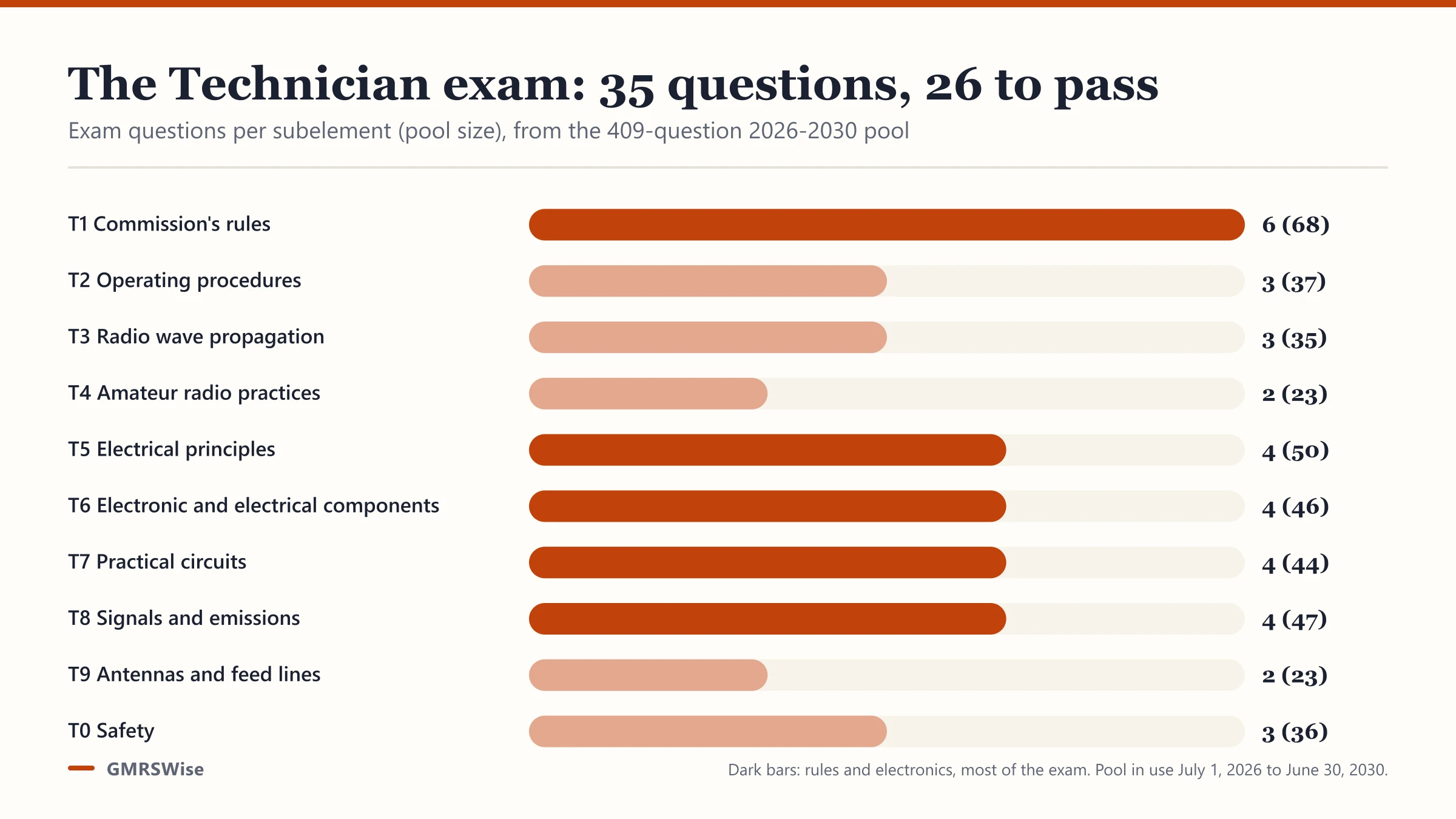
The Technician exam (FCC Element 2) has 35 questions drawn from 10 subject areas. The 2026-2030 pool, released by NCVEC in December 2025 with a February 2026 errata, is in use from July 1, 2026 to June 30, 2030.
| Subelement | Topic | Questions on the exam | Questions in the pool |
|---|---|---|---|
| T1 | Commission’s rules | 6 | 68 |
| T2 | Operating procedures | 3 | 37 |
| T3 | Radio wave propagation | 3 | 35 |
| T4 | Amateur radio practices | 2 | 23 |
| T5 | Electrical principles | 4 | 50 |
| T6 | Electronic and electrical components | 4 | 46 |
| T7 | Practical circuits | 4 | 44 |
| T8 | Signals and emissions | 4 | 47 |
| T9 | Antennas and feed lines | 2 | 23 |
| T0 | Safety | 3 | 36 |
| Total | 35 | 409 |
Rules and electronics together make up most of the exam. Many of the rules questions will feel familiar if you already hold a GMRS license: station identification, emergencies and power limits.
How do you study for the Technician exam?
Study the actual question pool, because every exam question comes from it. Download the pool from NCVEC, then pick one of three routes:
- Practice-test sites: free sites that drill the pool question by question and track weak areas.
- A license manual: books such as the ARRL Ham Radio License Manual explain the theory behind each answer, which helps with the electronics sections.
- A club class: many local radio clubs run short Technician courses that end with an exam session.
The pool is 409 questions. At 25 new questions a day, you can cover all of it in about 17 days, then spend the rest of your time on practice exams until you score well above 26 every time. Memorizing answers works for passing; understanding them makes the radio far more useful afterward.
Where can you take the ham radio exam?
At a session run by volunteer examiners under a VEC. The ARRL VEC and other VECs such as W5YI, GLAARG and Laurel VEC accredit the teams. The ARRL’s exam session search lists sessions by location; they are often held at libraries, community buildings and club meeting rooms.
Some VE teams also hold remote sessions over video. Each team sets its own rules for cameras, room setup and identification, so read the listing before you register.
For any session, the ARRL says to bring your FRN, a photo ID, and the exam fee if there is one. A calculator is allowed if its memory and formulas are cleared; phones and smart devices are not.
How long does it take to get a ham license?
Our estimate is two to four weeks from starting to study to transmitting, and most of that is your own study time. The paperwork after the exam follows a fixed sequence:
| Stage | What happens |
|---|---|
| Exam day | You receive a Certificate of Successful Completion of Examination (CSCE); the VE team sends your results to its VEC |
| After the VEC files | The FCC emails a payment link for the $35 fee |
| Payment window | 10 calendar days from the application file number; miss it and the FCC dismisses the application |
| After payment | A second FCC email with a link to your official license, valid for 30 days |
| Licensed | You may transmit once the grant appears in the ULS database |
If the application is dismissed for non-payment, the ARRL says you do not need to retest; the VEC can refile while your CSCE is still valid.
What can you do with a Technician license?
A Technician license gives full privileges on every amateur band above 30 MHz, at up to 1,500 W PEP, plus a few HF slices.
| Band | Technician privileges |
|---|---|
| 6 m, 2 m, 1.25 m, 70 cm and higher | All modes, full power: local repeaters, simplex, digital voice, satellites |
| 10 m | 28.000-28.300 MHz CW and data; 28.300-28.500 MHz CW and voice; 200 W PEP |
| 15 m | 21.025-21.200 MHz, CW only, 200 W PEP |
| 40 m | 7.025-7.125 MHz, CW only, 200 W PEP |
| 80 m | 3.525-3.600 MHz, CW only, 200 W PEP |
In practice, most Technicians use 2 m and 70 cm handhelds and mobiles through local repeaters. Our walkie-talkie range calculator includes 2 m and 70 cm handheld presets to compare against GMRS.
How do you upgrade to General or Amateur Extra?
Pass the next exam. General (Element 3) is 35 questions with 26 to pass and adds most HF voice privileges for worldwide contacts. Amateur Extra (Element 4) is 50 questions with 37 to pass and grants all US amateur privileges. The current pools are the 2023-2027 General pool and the 2024-2028 Extra pool from NCVEC.
Many VE teams let you attempt the next element in the same session once you pass the first; ask about any extra fee. Credit from a CSCE lasts 365 days, so a passed element is not lost if you come back later.
Why do GMRS users get a ham license?
The most common reasons are equipment freedom and range. A ham license makes a dual-band radio like the Baofeng UV-5R legal to use on ham bands, opens thousands of repeaters including internet-linked systems, and allows mobile power far above GMRS limits. It does not replace GMRS: it covers only you, while a GMRS license covers your family. The full trade-off is in GMRS vs ham radio, and the repeater side of GMRS is in GMRS repeaters.
Who is this guide not for?
This is the US process under the FCC. Outside the US, each country runs its own amateur exam and call sign system through its telecom regulator, with different classes, fees and privileges. If your goal is only to keep a family or group in touch on trips, a GMRS license with no exam is the faster route. And if you already hold a General or Extra license, this page covers ground you have already walked.
Where do these numbers come from?
Exam standards: 47 CFR 97.503. Technician power limits: 47 CFR 97.313. Fees: 47 CFR 1.1102. Question pool structure and dates: the NCVEC 2026-2030 Technician pool file (February 19, 2026 errata). Exam fee, what to bring, the FCC payment window and the under-18 fee program: ARRL’s Getting Licensed, “What to Bring to an Exam Session” and FCC application fee pages. Band privileges: ARRL frequency allocation chart. All checked October 2026.
Frequently asked questions
Quick answers to what readers ask us most
How much does a ham radio license cost?
$35 to $50 for most people: a $35 FCC application fee plus an exam session fee that the ARRL says is usually $15 or less. ARRL's VEC covers the $35 FCC fee for new candidates under 18. Study materials can be free.
How hard is the Technician exam?
It is 35 multiple-choice questions and you need 26 correct (74 percent). Every question comes from a public pool of 409, with the answers published, so steady study of the pool is enough for most people.
Can I take the ham radio exam online?
Yes. Some volunteer examiner teams run remote sessions over video as well as in-person sessions. Each team sets its own requirements, so check the session listing before you register.
How soon can I transmit after passing?
Only after your license grant appears in the FCC's ULS database. The FCC emails a payment link after the exam; you have 10 calendar days to pay the $35, and the license is issued after payment.
Is there an age limit for a ham radio license?
No minimum age. The ARRL notes anyone may hold a US amateur license except a representative of a foreign government. Children can and do take the Technician exam.
Does a ham license let me use GMRS?
No. GMRS is a separate FCC service with its own $35 license and certified radios. A ham license covers amateur bands only.