
What Does GMRS Stand For? The Name Explained
GMRS stands for General Mobile Radio Service, a licensed US two-way radio service on 30 UHF channels. What the name means, how to say it, and what it is not.
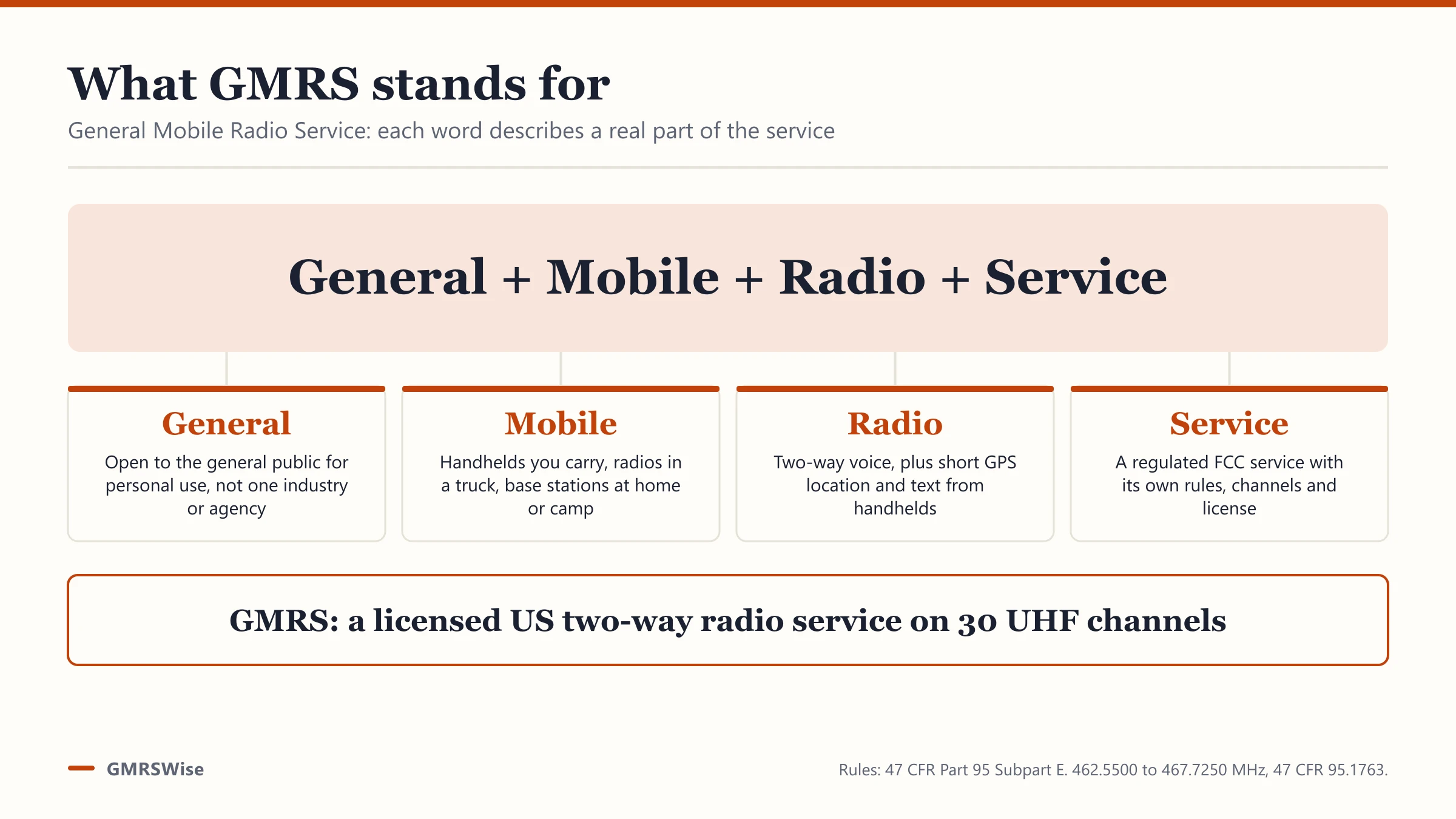
GMRS stands for General Mobile Radio Service. It is the name the FCC gives to a licensed US two-way radio service for families and small groups, defined in 47 CFR Part 95 Subpart E. The acronym turns up on radio boxes, forums and license paperwork, and the three words each describe a real part of how the service works.
What does GMRS stand for?
GMRS stands for General Mobile Radio Service. The letters come straight from the four words in the official name, with the middle word dropped from the acronym because “radio” is implied.
The service lives in 47 CFR Part 95 Subpart E. Section 95.1763 sets its 30 UHF channels between 462.5500 and 467.7250 MHz. That rule text is where the legal definition of GMRS actually sits, not on any product box.
What does each word in General Mobile Radio Service mean?
Each word describes a real limit or feature of the service. The name is more literal than most radio acronyms.
| Word | What it means for GMRS |
|---|---|
| General | Open to the general public for personal use, not a dedicated band for one industry or agency. Any eligible person may license it. |
| Mobile | Built for portable and vehicle use: handhelds you carry, radios mounted in a truck, and base stations at home or camp. |
| Radio | Two-way voice radio, plus limited data such as short GPS location and text from handhelds under 95.1731. |
| Service | A regulated FCC radio service with its own rules, channels and license, like FRS, CB or the Amateur Radio Service. |
So “General Mobile Radio Service” reads as a public two-way mobile radio service. That is exactly what it is.
What is GMRS used for?
GMRS is used for short-distance two-way voice between people who know each other: a family on a road trip, an off-road convoy, a hunting party, ranch and farm work, ski and hiking groups, and neighborhood emergency plans. It fills the gap between a toy bubble-pack walkie-talkie and ham radio.
It is popular because the license needs no exam and covers a whole family, while the radios can run more power and use better antennas than license-free FRS radios. Our GMRS radio guide covers the full picture of who it suits and what it costs.
Do you need a license for GMRS?
Yes, to transmit. Listening needs no license at all. The FCC license costs $35, needs no exam, lasts 10 years, and is issued to individuals who are at least 18 (47 CFR 95.1705). One license covers the holder and their immediate family, including a spouse, children, parents, grandparents, siblings and in-laws.
You apply online through the FCC’s licensing system and receive a call sign that starts with the letter W. The GMRS license walkthrough covers every screen and the renewal.
How is GMRS different from FRS, CB and ham radio?
GMRS sits between the free services and the hobby service. The quick comparison below shows where the name fits among the services people confuse it with.
| Service | License | Channels | Power |
|---|---|---|---|
| FRS (Family Radio Service) | None | 22 shared with GMRS | Up to 2 W |
| GMRS (General Mobile Radio Service) | $35, 10 years, no exam | 30 near 462 and 467 MHz | Up to 50 W |
| CB (Citizens Band) | None | 40 near 27 MHz | 4 W AM, 12 W SSB |
| Ham (Amateur Radio Service) | $35, exam required | Dozens of bands | Up to 1,500 W |
FRS radios can talk to GMRS radios because they share channels 1 to 22. CB and ham use entirely different frequencies and cannot. The channels and frequencies chart lists every GMRS channel.
Why do people search GMSR, FMRS or GRMS?
Those are misspellings of GMRS and FRS, and they point at the same two services. “GMSR” and “GRMS” are letter-swap typos for GMRS. “FMRS” blends FRS and GMRS into one, usually by someone who has seen both names on a radio box and is not sure which is which.
If you have a bubble-pack radio from a store, it is almost certainly an FRS radio, or a combined FRS/GMRS radio whose extra channels and power you may only use legally with a GMRS license. The GMRS vs FRS page explains which channels each service may use and at what power.
How did GMRS get its name?
GMRS grew out of the Class A Citizens Radio Service the FCC created in the 1960s for personal and local business two-way radio near 460 MHz. As the FCC reorganized Part 95 over the following decades, the service took the name General Mobile Radio Service to separate it from the low-power Citizens Band (CB) on 27 MHz.
The “General” in the name marked it as open to the general public, in contrast to the business and public-safety services that each had their own dedicated allocations. The structure used today, with a family-covering license and fixed UHF channels, is the modern form of that older personal radio service.
How many channels and how much power does GMRS have?
GMRS has 30 channels and allows up to 50 watts on its main channels. The channels split into groups by power limit, which is why the name’s “mobile” promise of vehicle and base radios only applies to some of them.
| Channel group | Count | Max power |
|---|---|---|
| Main 462 MHz channels (15-22) | 8 | 50 W from mobile and base radios |
| Shared channels (1-7) | 7 | 5 W ERP |
| Interstitial channels (8-14) | 7 | 0.5 W ERP, handhelds only |
| Repeater input channels (467 MHz) | 8 | Paired with the main channels |
The high-power main channels are what let GMRS act as a real mobile and base service rather than just another set of walkie-talkie channels. The channels and frequencies chart lists every channel and its limit.
What GMRS is not
GMRS is a short-range, line-of-sight UHF service, so a few plain facts save disappointment:
- It is not long range by default. Two handhelds typically reach about half a mile to two miles on the ground, not the 30-plus miles on the box. Height and repeaters change that far more than the brand does. Try the walkie-talkie range calculator for realistic numbers.
- It is not for businesses with staff. The license covers family, not employees, and the FCC no longer issues new business GMRS licenses.
- It is not usable outside the US under a US license. Other countries assign these frequencies differently.
- It is not a subscription or network service. There is no monthly fee and no cell coverage involved; the radios talk directly or through a repeater.
What should you do next?
If you just wanted the meaning, you now have it: General Mobile Radio Service, a licensed US two-way radio service on 30 UHF channels. If you are deciding whether to use it, read the GMRS radio guide for the full rundown, then compare it with the free option in GMRS vs FRS. When you are ready to transmit, the license walkthrough gets you a call sign in a few minutes for $35.
Frequently asked questions
Quick answers to what readers ask us most
How do you pronounce GMRS?
GMRS is said as four separate letters, gee-em-ar-ess. It is not pronounced as a word. Radio users often just say the full name, General Mobile Radio Service, on paperwork and the letters on the air.
Is GMRS the same as FRS?
No. FRS (Family Radio Service) is license-free and lower power on the same 22 shared channels. GMRS adds power, removable antennas and repeaters in exchange for an FCC license. See our GMRS vs FRS comparison.
What do people mean by GMSR or FMRS radio?
Those are common misspellings. GMSR is a typo for GMRS. FMRS mixes up FRS and GMRS. All three searches point at the same two services: the license-free FRS and the licensed GMRS.
Does GMRS stand for the same thing in other countries?
No. GMRS is a US FCC service. Other countries use their own license-free services, such as PMR446 in Europe and the UK, on different frequencies. A US GMRS license does not authorize use abroad.