
Midland Radios Explained: Which GMRS and FRS Models to Buy
Which Midland walkie-talkies need a GMRS license: X-Talker, LXT, GXT, MXT MicroMobile and BizTalk decoded, with October 2026 prices and FCC grant data.
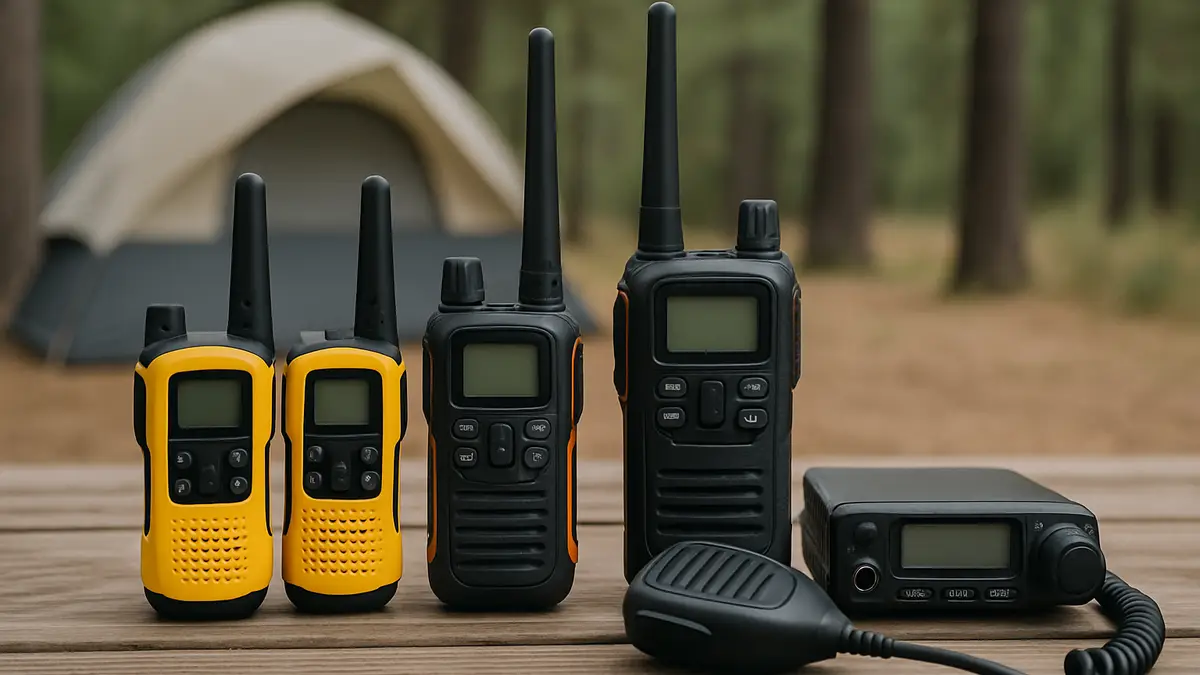
Midland Radio Corporation of Kansas City, Missouri, sells license-free FRS radios, GMRS handhelds, GMRS vehicle radios and business radios under overlapping names, which makes the license question harder than it needs to be. Some X-Talkers are license-free and two are not. Some radios called “GMRS” on the box carry 2.5 W, others carry 50 W. This page sorts the lineup by what matters first, whether you need a license, then by what each line is for.
Which Midland radios need a GMRS license?
Midland’s GXT handhelds, MXT MicroMobile vehicle radios and the X-Talker T290 and T295 are GMRS radios and need an FCC GMRS license. The X-Talker FRS models and the LXT line are FRS and need no license. BizTalk business radios split both ways.
| Line | Service | License needed | Models on midlandusa.com | Price (Oct 2026) |
|---|---|---|---|---|
| X-Talker T10 to T77 | FRS | No | T10, T31, T51, T61, T71, T75, T77 | $39.99 to $119.99 per pack |
| X-Talker T290, T295 | GMRS | Yes, GMRS | T290VP4, T295VP4 2-packs | $109.99 |
| LXT | FRS | No | LXT500, LXT600, LXT630 | $59.99 to $109.99 per pack |
| GXT | GMRS handheld | Yes, GMRS | GXT1000, GXT1030, GXT1050, GXT3000, GXT67 Pro | $49.99 single to $219.99 |
| MXT MicroMobile | GMRS mobile | Yes, GMRS | MXT105, MXT115P, MXT275, MXT295 Pro, MXT500, MXT575 | $129.99 to $459.99 |
| BizTalk FRS | FRS | No | BR10, LXT600 business packs | $119.99 to $474.99 per pack |
| BizTalk business band | Part 90 business | Yes, FCC business license | BR180, BR200, MB400 | $119.99 to $164.99 each |
The GMRS license costs $35, lasts 10 years and covers the licensee’s immediate family. The full process is in our GMRS license walkthrough.
What is the difference between X-Talker, LXT and GXT?
X-Talker and LXT are Midland’s license-free FRS families for casual use, and GXT is its GMRS handheld family for licensed users who want more power, the 467 MHz repeater channels, or both. The catch is that the X-Talker name now also covers two GMRS models, the T290 and T295, so read the box for “GMRS” or “FRS” rather than the series name.
An FRS radio is legally capped at 2 W effective radiated power on channels 1 to 7 and 15 to 22, with a fixed antenna (47 CFR 95.567 and 95.587). That cap makes X-Talker and LXT radios simple and legal for anyone, including a business, but it also caps range. If the people you talk to are within a campground, a ski hill or a subdivision, FRS is usually enough. Our GMRS vs FRS comparison walks through the trade in detail.
How do the GXT handhelds compare?
The GXT67 Pro is the only current GXT with a published 5 W rating, the GXT3000 adds repeater channels at a mid price, and the GXT1000 is the low-cost entry pair without listed repeater support. We checked the FCC equipment grants for the models that have one on record.
| Model | Price (Oct 2026) | Repeater channels | Weather rating | Privacy codes | FCC grant we checked |
|---|---|---|---|---|---|
| GXT1000 | $49.99 single, $99.99 pair | Not listed | JIS4 splash | 142 | Not located on fccid.io |
| GXT1050 (camo) | $119.99 pair | Not listed | Not checked | 142 | MMAGXT1050G: 2.5 W ERP on 462 MHz channels |
| GXT3000 | $169.99 pair | 8, per Midland | JIS4 splash | 142 | MMAGXT3000 (June 2023): 2.35 to 2.42 W ERP on 462 MHz |
| GXT67 Pro | $219.99 single | 8, split tones | IP67 | 142 | MMAGXT67 (Oct 2023): about 4.9 W on 462 and 467 MHz main channels |
The power numbers come from the grant tables, which state the certified power on each channel group. The GXT1050 and GXT3000 records list about half the 5 W ceiling that GMRS allows a handheld on channels 1 to 7, which is why Midland’s own GXT1000 page says the radios “average 1/2 to 2 miles in normal conditions” despite the 36-mile headline.
Who should buy the GXT67 Pro?
The GXT67 Pro is for a licensed GMRS user who wants the most capable Midland handheld: about 5 W on the main and repeater channels per its FCC grant, IP67 dust and water protection, 99 channel slots and split-tone repeater programming. At $219.99 for a single radio it is also the most expensive handheld in the lineup.
Midland claims the GXT67 Pro “can easily reach up to 5 miles, depending on terrain”, a more honest headline than the 36-mile box figures on older GXT packs. In wooded or suburban ground, two handhelds still land well under that, and a repeater changes the picture far more than the radio does.
Who it is not for: families who only need to talk across a campsite (an FRS pair at a quarter of the price does that), and anyone who will not get the GMRS license, since every GXT transmits on GMRS.
Which MicroMobile fits your vehicle?
The MXT MicroMobiles are Midland’s GMRS vehicle radios: 5 W, 15 W and 50 W versions, most with 8 repeater channels and a magnet-mount antenna in the box. A 15 W MXT275 at $199.99 is the common overland and off-road pick; the 50 W MXT575 at $439.99 is for long convoys, ranch use and repeater work from far out.
| Model | Power | Repeater channels | Notable | Price (Oct 2026) |
|---|---|---|---|---|
| MXT105 | 5 W | Not listed | Smallest, detachable magnet-mount antenna | $129.99 |
| MXT115P | 15 W / 5 W | 8 | Adjustable color backlight, IP67 microphone | $219.99 |
| MXT275 | 15 W | 8, split tone | Control microphone (MA75) | $199.99 |
| MXT295 Pro | 15 W / 5 W | 8 | Wireless Bluetooth microphone, IP67 | $299.99 |
| MXT500 | 50 / 25 / 5 W | 8, split tone | Controls on the radio, IP66 | $439.99 |
| MXT575 | 50 W | 8, split tone | Hideaway unit, controls in the microphone | $439.99 |
The MXT575 grant (MMAMXT575, April 2021) lists 48.87 W on the 462 MHz main channels, 46.67 W on the 467 MHz repeater inputs and 4.08 W on channels 1 to 7, consistent with the 5 W ERP limit there. For a ranking across brands, see our GMRS mobile and base radio picks.
Does the stock MicroMobile antenna hold the radio back?
Usually yes. The MXT275 and MXT115P ship with Midland’s MXTA13, a 2.1 dB magnet-mount antenna sold separately for $34.99. Midland’s own upgrades are the MXTA25 (3 dB, NMO mount, $64.99) and MXTA26 (6 dB whip, NMO, $74.99).
A higher-gain antenna on the roof center adds more usable range than stepping from 15 W to 50 W in many cases. In our range calculator, two 50 W mobiles on rolling ground with light trees go from about 2.7 miles reliable with unity-gain magnet antennas to about 3.8 miles with 3 dB antennas. Note that channels 1 to 7 carry a 5 W ERP limit that counts antenna gain, so keep high-gain setups on channels 15 to 22.
How do Midland privacy codes work?
Midland’s GXT handhelds, the MXT275 and the MXT575 use 142 privacy codes (38 CTCSS tones plus 104 DCS codes), while the newer MXT115P, MXT295 Pro and MXT500 list 154 codes (50 CTCSS plus 104 DCS), and the X-Talker T290 page lists 121. Mixing generations can mean the same code number points to a different tone.
Privacy codes do not make a conversation private; anyone on the channel with codes off hears you. They only mute other groups. When pairing a Midland with another brand, set the tone by its frequency, not by the brand’s code number. Our privacy codes guide has the full CTCSS and DCS tables.
Who should skip Midland entirely?
Midland is a strong default for families and vehicle users, but three groups should look elsewhere. Business teams that need durable, shift-long radios on exclusive frequencies should look at Part 90 business radios through a dealer. Ham operators who want one radio for 2 m, 70 cm and GMRS cannot have it legally (47 CFR 95.1761(c) bars GMRS certification for ham-capable radios). Buyers outside the US should buy local PMR446 or equivalent radios, because GMRS is a US FCC service.
Budget GMRS buyers who want removable antennas and repeater support for under $50 per radio will find options in our best GMRS radios comparison, where Midland competes with BTECH, Baofeng’s Part 95E models and Rocky Talkie.
How we checked these radios
We did not field-test Midland radios. Prices and specs come from midlandusa.com product pages, checked October 2026. Certified power and channel coverage come from the FCC equipment authorization records for Midland’s grantee code MMA, read through fccid.io. Range figures come from our calculator model or from Midland’s own statements, quoted as such. Where a grant could not be found, the table says so.
Frequently asked questions
Quick answers to what readers ask us most
Do Midland walkie-talkies need a license?
It depends on the line. X-Talker FRS models and LXT radios are license-free FRS. GXT handhelds, X-Talker T290/T295 and MXT MicroMobiles are GMRS and need an FCC GMRS license ($35, 10 years, covers immediate family).
How far do Midland GXT radios really reach?
Midland's own GXT1000 page says the 36-mile figure assumes mountaintop to mountaintop and that the radio averages 1/2 to 2 miles in normal conditions. Our range calculator gives a similar answer for handhelds in trees or houses.
Which Midland handheld works with GMRS repeaters?
Midland lists repeater capability for the GXT3000 and GXT67 Pro, not for the GXT1000. The GXT67 Pro FCC grant (MMAGXT67, October 2023) shows near-5 W on the 467 MHz main channels that repeaters listen on.
Can Midland GXT radios talk to Motorola Talkabout radios?
Yes, on channels 1 to 22 with privacy codes off or set to the same tone. Midland and Motorola number their codes differently, so match the actual CTCSS tone or DCS code, not the code number.
Is the Midland MXT575 worth it over the MXT275?
Only if you need range beyond a 15 W radio or plan repeater use from deep in the backcountry. The MXT575 is $439.99 and 50 W; the MXT275 is $199.99 and 15 W. Antenna height usually adds more range than the extra watts.