
GMRS for Hunting: Radios, Range, and Legal Setup
How hunters use GMRS to stay in touch: which radios suit a hunting party, real range in timber, legal channels, and why GMRS beats toy walkie-talkies.
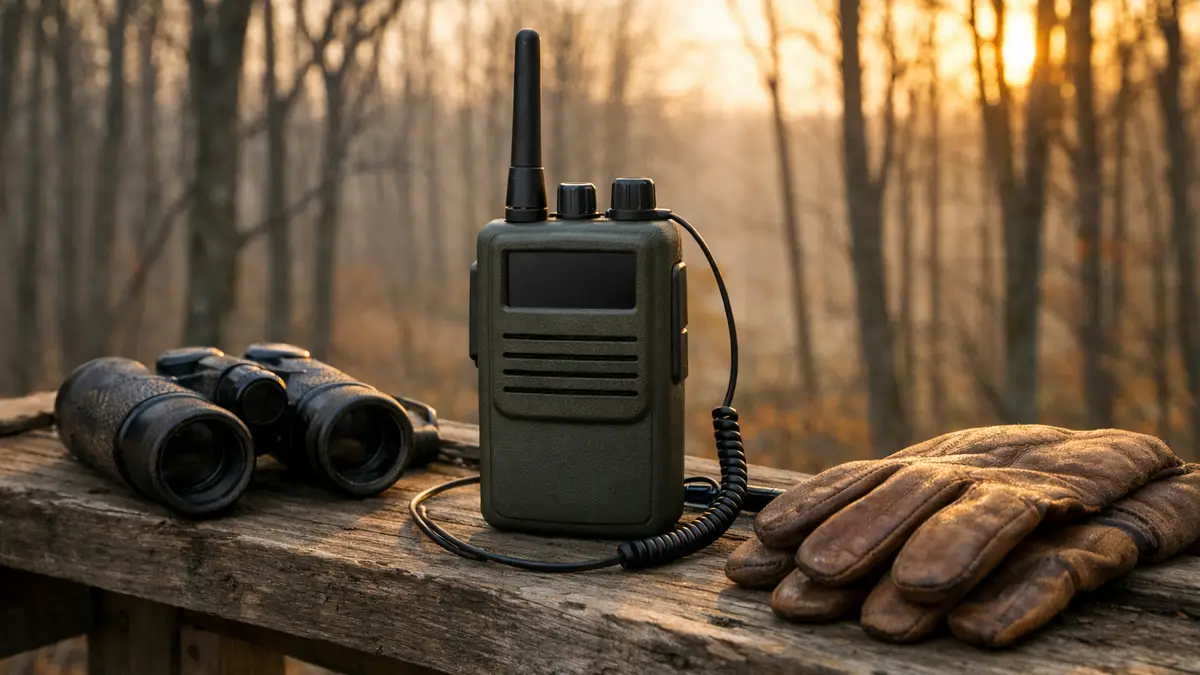
GMRS is a strong fit for hunting parties because the single $35 license covers a whole family, the handhelds run more power than toy radios without an exam, and UHF audio stays clear in the field. The catch is range: in timber and hills, even good radios reach only a few tenths of a mile, so success comes from planning positions and check-in times, not from the brand on the radio.
Why use GMRS for hunting?
GMRS lets a family hunting party talk legally on clearer, more powerful radios than bubble-pack FRS units, under one license that covers everyone related to the holder. There is no exam, the license costs $35 for 10 years, and a 5 W handheld plus a decent antenna outperforms a 2 W FRS radio.
For hunters, the practical wins are clear UHF audio that cuts through wind and distance, the option to use a vehicle or base radio back at camp as a strong station, and privacy codes that keep your channel quiet. The GMRS radio guide covers the service in full.
How far will GMRS reach in hunting country?
In heavy timber, brush and rolling hills, expect about 0.3 to 0.6 miles between two 5 W handhelds. Open ridgelines and fields push that higher; thick forest and deep draws cut it to a few hundred yards. UHF signals are blocked by trees and terrain far more than most hunters expect.
| Terrain | Radios | Typical range |
|---|---|---|
| Heavy timber, hills | Two 5 W handhelds | 0.3 to 0.6 mi |
| Mixed woods and fields | Two 5 W handhelds | 0.6 to 1.2 mi |
| Open ridge to ridge | Two 5 W handhelds | 1.5 to 3 mi |
| Camp base radio to field | 50 W base, roof antenna, to handheld | 2 to 5 mi |
These figures come from our walkie-talkie range calculator. Plan stand positions and check-in times around the short end, not the long one.
What GMRS radio is best for hunting?
Pick a rugged, water-resistant 5 W handheld with long battery life and a quiet, simple interface. A camo or dark body helps, as does a radio you can work by feel without looking. Our best GMRS radios comparison ranks handhelds on power, water rating, battery and antenna.
If your party uses a fixed camp, add a vehicle or base radio there as the strong station so someone at camp can hear hunters spread across the property. For wet or snowy seasons, prioritize a sealed radio; see best waterproof walkie-talkies.
How should a hunting party set up radios?
Keep it quiet, short and planned. A few field habits matter more than gear:
- Agree on a channel and privacy code before you split up, and do a radio check from your stand.
- Set check-in times (for example on the hour) rather than chattering, to save battery and keep the woods quiet.
- Use an earpiece so incoming calls do not spook game; see the walkie-talkie earpiece guide.
- Keep transmissions short. Say your position and status, then release.
- Turn down roger beeps and key tones that carry in still air.
Is it legal to use radios while hunting?
Owning and using GMRS or FRS radios in the field is legal with the proper license, but how you use them can be restricted. Several states prohibit using two-way radios or other electronic devices to take game, such as coordinating a shot on an animal between hunters. The radio itself is fine; using it to pursue or take game may not be.
Check your state wildlife agency’s regulations before the season. The federal radio rules (the GMRS license and operating rules) and the state game laws are two separate things, and both apply.
What accessories help with GMRS in the field?
Pick accessories that keep you quiet and keep the radio running:
- An earpiece or throat mic, so calls do not carry to game; see the walkie-talkie earpiece guide.
- Spare batteries or a case that takes AA cells, for multi-day hunts away from power.
- A chest or shoulder harness, to keep the radio reachable without noise.
- A short flexible antenna if you move through brush, trading a little range for durability.
- A dark or camo body, with roger beeps and key tones turned off.
GMRS versus a cell phone for hunting
A GMRS radio and a phone solve different problems. A phone needs cell coverage, which is often missing in hunting country, and it only reaches one person at a time. A GMRS radio works with no network and talks to the whole party at once, which is what coordinating a drive or a meetup needs.
Carry both where you can: the radio for talking to your group, and the phone or a satellite messenger for reaching the outside world in an emergency. Neither replaces the other in the backcountry.
What features matter most in a hunting radio?
Rank these when choosing a handheld for the field:
| Feature | Why it matters hunting |
|---|---|
| Water resistance | Rain, snow and dropped radios |
| Battery life and AA option | Multi-day hunts with no charging |
| Quiet operation | Mutable beeps, earpiece jack |
| Power (5 W) | A little extra reach in mixed terrain |
| Rugged, glove-friendly body | Cold hands and rough handling |
The best GMRS radios comparison scores handhelds on these. A clear, rugged radio you can work by feel beats a feature-packed one you fumble with cold hands.
Should you run a base station at hunting camp?
A base or vehicle radio at a fixed camp is worth it when hunters spread across a large property. A 50 W radio on a raised antenna at camp can hear handhelds a few miles out, far better than handheld to handheld.
Set it up before the hunt, confirm everyone shares the channel and privacy code, and keep the camp radio monitored. For gear, see the best GMRS mobile and base radios page.
Who should skip GMRS for hunting?
GMRS is not right for every hunter:
- Solo hunters in remote country gain little from a two-way radio with no one in range; a satellite messenger is the safety tool there.
- Large unrelated hunting groups cannot all ride on one license, since it covers family only. Each separate household needs its own.
- Anyone wanting miles of reliable range in forest will be disappointed by any handheld. Range in timber is short no matter the radio.
Start by deciding between license-free FRS and licensed GMRS in GMRS vs FRS, then get the GMRS license if the power and antenna options are worth it for your party.
Frequently asked questions
Quick answers to what readers ask us most
Do you need a license to use GMRS for hunting?
Yes, to transmit. The $35 FCC GMRS license needs no exam, lasts 10 years and covers your immediate family, which suits a family hunting party. A non-family hunting buddy needs their own license. Listening needs no license.
How far will GMRS radios reach in the woods?
In heavy timber and hills, expect about 0.3 to 0.6 miles between two 5 W handhelds. Trees and terrain cut UHF range sharply, so set positions and check-in times that assume short range rather than miles.
Are GMRS radios better than FRS walkie-talkies for hunting?
GMRS handhelds can run 5 watts versus 2 watts for FRS and can use better antennas, so they reach a little farther and sound clearer. For a family that hunts often, the license is usually worth it. See our GMRS vs FRS page.
Is it legal to use two-way radios while hunting?
Using GMRS or FRS radios is legal, but some states restrict using radios or electronic communication to take game (for example to coordinate a shot on an animal). Check your state's game regulations before you hunt.